Category Archives: attribution theory

"T’es folle ou quoi?"


French slang for, “Are you crazy, or what?” Also, the title of a 1982 comedy, ads for which were plastered all over the Metro station walls that winter [the coldest on record, at the time]. It became my lingua franca catchphrase during our Eurail Pass honeymoon, as effective in Milan and Vienna as it was in Paris, to back off street hasslers without giving offense. It conveyed the power subtext, “I am not your victim, nor am I your enemy,” in a way that the more common but histrionic “Laissez-moi!” [“Leave me alone!”] just misses.

As effective as the phrase is, after 40 years of close, professional encounters with Those Who May Be Crazy, I don’t like its implication. Now, for a bit of Attribution Theory. Do you imagine that what I object to is the use of a derogatory term for those suffering from Mental Illness? Not me. Sticks & stones and all that. I object, Ladies & Gents, to the overuse of the Insanity Defense, to excuse wolfish behavior, nar’mean?

In March of 1981, you may recall or have read, one John Hinckley, Jr. fired 6 exploding bullets at President Reagan, hoping to win the admiration & love of the actress Jodie Foster. He was a lousy shot, and managed to kill and maim several people; but only one ricocheting bullet entered the armpit of the President, who survived. The shooter copped an Insanity Plea [which a DC jury bought] and remains to this day an inpatient @ St. Elizabeth’s Hospital in Washington, DC [which advertises monthly for clinical staff, if you’re interested in a job opportunity]. For years, he has been granted weekend passes to visit his parents.

I’m no fortune teller, but I bet the Tucson shooter’s defense team are pouring over the transcripts of the Hinckley trial, to unearth bits of jury-swaying gold dust. A spate of articles, both in the popular and scientific press, have addressed the thorny “T’es folle ou quoi?” question, in hopes of being better able to identify and forestall future pistol-packin’ werewolves from acting out. Presciently, in the 24 July 09 issue of the Schizophrenia Bulletin, William T. Carpenter wrote a pros & cons think piece, “Anticipating DSM-V: Should Psychosis Risk Become a Diagnostic Class?” Under “cons,” he notes that the proposed criteria for a diagnosis of Psychosis Risk Syndrome [PRS] or Attenuated Psychotic Symptoms Syndrome [APS], are commonly found in “non-ill” young people; and so the risk of needless stigmatisation and overtreatment is high.

Even if the Syndrome makes it into the next edition of the so-called “Book of Broken Things,” the last people who are going to be able to inform the authorities about a perceived loose cannon will be Mental Health providers. Unless HIPAA is amended or repealed, that is. Back in the day, in pre-HIPAA times, one of my jobs as an active duty Navy Psychologist was to do annual assessments of veterans receiving disability pensions for service-connected Mental Illness. It was a Hobson’s Choice the vet faced in his interview. Too sane, and he would lose his benefits. Too crazy, and he might get rehospitalized on the spot. In the summer of 1981 a vet told me that it was his ambition, “to become another Hinckley.” Without fear of litigation or loss of my license to practice psychology, I informed my Department Head, who called the FBI, who arrived promptly, to “continue the interview process” with the vet.

Couldn’t get away with that nowadays. Not even sure if I could get away with remarking, to a weird-acting, in-my-face pavement artist on the streets of Paris, “T’es folle ou quoi?” But I bet he could get away with murder.
Leave a comment

Filed under aggression happens, attribution theory, power subtext, suicide and murder

"Don’t Sit Down ‘Cause I’ve Moved Your Chair"


In the latest issue of Spin magazine, Arctic Monkeys frontman Alex Turner explains how a song was “born”: “We were in the studio and I pulled someone’s chair out.”

Do ya see, now, he was trying to circumvent Gestalt psychologist Edward Tolman’s Expectancy Effect, defined in The Dictionary of Psychology [ed. Ray Corsini, 2002] thus: “a tendency for an expectation to cloud a person’s ability to observe or reason, that may lead to an error or bias in the direction in which the person expected the results to go.” Or, to apply Occam’s Razor, we are all creatures of habit. We expect a chair to be where it usually is.

When I say “all,” I include Tolman’s lab rats, who were trained to run a maze, at the end of which they had come to expect a High-Value Treat. When the fiendish experimenter substituted a Treat of Lesser Value, “the rats displayed disgust.”

There is a British idiom, “Sick as a parrot!” Maybe its corollary could be, “Disgusted as a rat!”

The Expectancy Effect does not always result in disgust [or a pratfall from sitting down where a chair no longer is]. Sometimes it causes a better-than-it-really-is distortion [called a Positive Halo Effect in Educational Psychology, where certain students are given the benefit of the doubt & inflated scores, while others (under a Negative Halo) are expected to do badly & downgraded accordingly].

Get this, from yesterday’s London Evening Standard. A man [who had recently quit taking his meds] fatally stabbed a perfect stranger in the street, because he “mistook him for a Zombie.” See? If you’re expecting Zombies, you’re likely to “see” them everywhere.

Oh, come on. Who hasn’t done it? Your beloved black cat has died, and now every dark sweater or towel, glimpsed out of the corner of your eye, “is Midnight!” It’s only delusional if you open a fresh can of FancyFeast for “him.” In certain cultures, not even then.

Returning to the Zombie hunter example, hands up if you expect all rich Frenchmen [or rich Italians, for that matter] to be lechers. Or all mothers to be paragons of virtue.

Oopsie daisy! It ain’t necessarily so. Rules of thumb concerning human nature, like chairs, are subject to change without prior notification.

Leave a comment

Filed under aggression happens, attribution theory

Wolverhampton Wolves


I refer not to that ancient city’s alliteratively nicknamed football club [officially, the Wanderers], but to the flash-mob packs of masked looters and arsonists, who are the subject of my contempt, yet also of my attempt to understand what on earth has got up their noses this week.

That sociological sage [and, allegedly, appalling father] John Phillips, late of The Mamas and the Papas, wrote these lyrics to “Safe In My Garden” (1968), concerning the rioting youth of that era: “Could it be we were hot-wired? Late one night; we’re very tired. They stole our minds and thought we’d never know it. With a bottle in each hand; too late to try to understand. We don’t care where it lands–we just throw it. When you go out in the street, so many hassles with the heat [hippie slang for the police]; no one there can fill your desire. Cops out with the megaphones, telling people stay inside their homes. Man, can’t they see the world’s on fire?”

The riots he was describing ostensibly arose from the twin “root causes” of an unpopular war [Vietnam] and racial injustice in 20th Century America; yet he posits a very 21st Century “spark” that ignited that summer of burning cities: some kind of subliminal, electronically-mediated GroupThink, that robbed young people of their individual will and transformed them into the mobile vulgus [the wandering mob], wreaking seemingly random havoc, but not getting much satisfaction from it. Pretty prescient, for a guy who died in the Spring of 2001, no?

Many of this week’s unrepentant pillagers, when asked by BBC reporters, what got up their noses to provoke such displays of rage, answered, “It’s a Class War, innit? We’ve got nuffink, so we’re takin’ it from the rich, nar’mean?” Mind you, they all seemed to own Blackberries, on which they BBM’d {“hot-wired”?] each other the list of successive targets, most of which were modest “mom & pop” shops owned by Sikhs & Hindus [not by “rich snobs,” as one boy put it]. So, why the disconnect between the looters’ Robin Hood myth of robbing the rich, and the reality of their robbing the barely-making-ends-meet South Asian shopkeepers?

Well, [pace The News of the World] I blame the UK’s gutter press, of which The Daily Mail is the prime surviving example, whose narrative subtext is “Everyone we photograph is richer, luckier, and more powerful than you, Dear Reader. Envy them. Feel humiliated by them. Cut them down to size, if you get the chance.” That’s right. I blame the media for the mayhem that continues to spread throughout England tonight, perpetrated not by “werewolves” [who spend the daylight hours adhering to the social norms] but by packs of wolfish youths [boys and girls] who declared proudly to daytime reporters, “No snobby cop’s going to tell us what to do!”
Yeah, right. But the cynical editors of The Daily Mail and their ilk are profiting from your shenanigans. Their motto is: “Long live the Class War! [Let’s hope there are still some corner shops left tomorrow, to sell our Schadenfreude.]”

Leave a comment

Filed under aggression happens, attribution theory, understanding shenanigans

Never the Same Woods Twice


Or maybe it is? Pre-Socratic philosophers started debating this point around 500 BC. Heraclitis may (or may not) have said “Panta rhei” [“Everything changes (or, possibly, flows)”], famously declaring that one could never dip one’s toe into the same stream twice. Pamenides, on the other hand, was an early conservation-of-matter guy, declaring “Change is impossible.” There is nothing new under the sun. [Not even the sun.] Wade Lassister set this idea to music in the finale of the 1980 musical & film, Fame: “I sing the body electric (a line lifted directly from Leaves of Grass). I celebrate the me yet to come. I toast to my own reunion, when I become one with the sun.” The song ends cute with the astrophysical & show biz prediction, “and in time, and in time, we will all be stars.”

It’s still a hot topic for Presidential candidates, whether the Earth’s climate is actually, irreversibly changing, or just going through what David Bowie might call one of its cyclical “Ch-ch-changes.” If only we were French, and could simply finesse the argument with a bon mot: “Plus ca change, plus c’est le meme chose.”

For a while this summer, every walk in the woods lent support to what Parmenides termed dismissively “the mistaken opinion that things had changed.” In the wake of the earthquake, and tropical storms, many mighty trees had fallen. Some of them, eerily, days later. [Thank goodness for Lili, the “timberwolf,” who in the past has given me a “heads up” of falling lumber, and so allayed my fear of being poleaxed.]

But falling trees have not been the only hazard on our woodland walks this summer. A few weeks ago we were assailed by an unleashed, Hound-of-the-Baskervilles-type dog, who came growling and charging at us, leaving its (oblivious? psychopathic?) master far behind. It was fear that got up my nose, but Lili might have been merely affronted by the intrusion. In the melee of snarls & skirmishes that ensued, I was dragged off my feet (not once, but twice), in an attempt to keep hold of Lili’s leash. Only when I was on the ground the second time, did the other owner speak. “I’ll call my dog, and he’ll follow me,” he said. By now, my humiliation and pain & suffering had banished all Japanese commands from my consciousness, and I was reduced to shouting “God damn it!” to all and sundry. I can vouch for the efficacy of swearing as an analgesic, though [see “Why Keep a Dog & Bark Yourself?”]. On the wings of my adrenaline, we flew through the woods in record time; and only later at home, when the bruises “bloomed,” did I realize that I could have been seriously injured.

Since then, I have “played Backgammon” with the incident, revisiting it in my mind, trying to figure out what would have been a better “Not your victim, not your enemy” response to the situation, to make it stop haunting me. In retrospect, I decided I should have told the owner to grab hold of his dog. [Nar’mean?] I should also have taken off my over-the-shoulder European leash and held it in both hands, for better leverage. Every time I’ve seen his telltale Range Rover illegally parked at the entrance to the woods (where are the police when you want them?), I have rehearsed my “flame-out chart” what-to-do list, ready for action.

Yesterday was the rematch. This time, the owner was strolling even farther behind his snarling, charging dog. Initially, I commanded Lili [in our Japanese code] to “lie down” and “stay”; but when the other dog made aggressive contact, I realized our power subtext was “lame gazelle,” so I just held onto Lili’s leash as she barked and lunged. This time I yelled, “Do you have a leash?” No reply. Eventually, the owner called “Skipper” a few times, and reluctantly the dog left the fray and headed back to its master, only to turn around and make a second sortie. This time I shouted, “Do you have a leash?” until he beckoned Skipper again, and they proceeded on their way.

So, that was my Parmenidian moment: “Nothing changes. You can try to rewrite the script, but you’ll still end up looking (and sounding) like a shrill, histrionic loser who can’t take the heat, while the smug thug with the flash car and the free-range dog looks like a winner.”

Ah, but was it a complete rerun? At least this time I didn’t fall down and get dragged like a rodeo clown; and I communicated clearly that the guy should have put his dog on a leash [which is both the custom and the law in these woods]. So, encouraged, we forged ahead with our walk.

Just as we were cresting the hill where the mid-summer fracas had occurred, I made out the outlines of a tall man and a large dog approaching. But I took the Heraclitian view, that these two were not my old nemeses, that each man/dog encounter was “a different stream,” and that things might turn out differently for us this time. So I put Lili at a “down/stay,” ensuring her compliance by stepping on the leash to keep her there. A totally different man, with a Cockney accent and a huge black lab on a chain, smiled as they passed peaceably by, and said, “I do that, too. I put my foot on the lead sometimes, for more control.”

Heraclitis was right! It’s never the same woods twice.

Leave a comment

Filed under attribution theory, gets right up my nose, power subtext

The Uncanny Valley


This highly technical term, coined in the 70s by the Japanese roboticist, Masahiro Mori, could just as well be the title of a Hollywood horror flick, nar’mean? What Mori-san meant, though, was that sudden dip in a graph measuring the “appeal” of humanoid robots, that occurs when The Thing looks both Too Human, yet Not-quite Human, and the observer gets freaked out.

Dr. Christian “Jeepers” Jarrett’s article, “The Lure of Horror,” in the Halloween issue of The Psychologist, tries to account for the apparent predilection among current cinema-goers [it’s a British journal] for being freaked out. Despite what you might gather from the weekly Box Office grosses listed in The Hollywood Reporter, not everyone craves creepiness. In fact, it’s mostly males aged 6 to 25 who really dig “trips” to the Uncanny Valley. The rest of us get quite enough of that eery sensation, thank you very much, from our nightmares, hypnogogic illusions [in that twilight state between sleep & waking], and the weird coincidences of everyday life.

The concept predates modern film-making. Freud & his contemporaries were writing articles about Das Unheimliche [the Uncanny] in the early 1900s, pondering the scariness of dolls with missing eyes [remember the cartoons of Orphan Annie?], clowns, and anyone hiding their face behind a mask [or veil]. The limbic explanation, then and now, is that we vulnerable mortals need all the visual cues we can get, to determine whether a stranger poses a threat or not. If we think someone is PLU [People Like Us], and suddenly the mask slips, to reveal that they are [gasp!] non-PLU, our visceral response may be so dramatic that we get vertigo.

Back in the day, when I was a VA Trainee, I was interviewing a young “woman” veteran, to assess whether the first government-funded sex-change operation would increase or decrease his/her suicidal acting out. I had lived in Greenwich Village, the mecca of glamorous transvestites; but the individual before me looked and acted more like an Amish farm girl. When I asked about an incident from adolescence, the person’s voice, body language and facial expression morphed into the 16-year-old boy he had been; and I nearly fell out of my chair. It wasn’t scary; it was uncanny. We both had a good laugh about it, and carried on with the interview, in the safe surroundings of the Manhattan VA hospital. As a transsexual individual trying to live a “normal” life in 1970s NYC, however, the uncanny feelings my patient evoked in macho men often turned violent. [ See The Crying Game, not so much Tootsie.]

In this regard, Jarrett reports a startling finding from my least favorite research tool, the fMRI. 40 subjects watched creepy clips from scary movies and also boring clips from the same films. The researchers expected the amygdala to light up during the creepy bits; but, no, the intracranial wolf did not howl. What lit up were the “visual cortex, the insular cortex (a region involved in self-awareness) and the thalamus (the relay centre between the cortex and the sub-cortical regions).” I hate to admit it, but this is heavy. It suggests that members of that coveted demographic, males between 6 and 25, do not seek out horror films to get scared. They are there to get schooled. They are practicing [in what they are quite aware is a safe, pretend setting] vigilance. They’re getting good at discriminating the PLU from the non-PLU, innit?

Their motto is not, “Jeepers, creepers!” It’s “We won’t be fooled again.”

Leave a comment

Filed under attribution theory, limbic system, sharks and jets

No Teddy Bears’ Picnic


If you’re familiar with Harry Hall’s 1932 recording of “The Teddy Bears’ Picnic, ” you’re in distinguished company. For more than 30 years, BBC sound engineers used it to check frequency cycles before broadcasts, because of the fidelity of the recording and the wide-ranging pitches of the little ditty. Tell you something else that was wide-ranging: Irish lyricist Jimmy Kennedy’s various attributions of the danger posed by Teddy Bears in the woods. For a supposedly light-hearted children’s song, it’s as full of dark foreboding as a Twilight flick. “If you go into the woods today, you’d better go in disguise…you’d better not go alone. It’s lovely out in the woods today, but safer to stay at home.” And why all the angst? “Today’s the day the Teddy Bears have their picnic.”

I’m not a big fan, never was, of sending mixed messages to children about safety hazards. Seems to me there are enough truly scary things and situations out there “in the woods” to worry about, without setting up “straw men” like picnicking Teddy Bears, nar’mean? But that’s me being literal-minded, rather than Poetic, about it. I’ve read [and recommended] Bruno Bettelheim’s book, The Uses of Enchantment, the point of which is, that Grimm fairy tales [and zombie films, and their ilk] afford a less amygdala-setting-off, more reassuringly metaphorical way of facing our fears.

About 2 months ago, as Chris & I were walking Lili into the thick of the woods, a middle-aged woman [I should talk!], clad in a brown velour track suit which the 80s wanted back, jogged up to us and said, “Better be careful! There are police in the woods!” Intrigued, Chris & Lili forged ahead, while I stumbled behind them [my ankles suddenly turning to jelly from anxiety]. “A dead body? An armed & dangerous felon?” I wondered. What did their presence betoken, that had so freaked out the Lady in Velour? When Chris saw them, he asked “What’s up?” They said, “We’re looking for hunters.” They were U.S. Federal Special Police Officers, from the Smithsonian Institution Office of Protection Services [Did I mentions that “our” woods are a Smithsonian nature preserve?], acting on a tip that hunters had been spotted in the area. So we regaled them with anecdotes of our many encounters with [apparently illegal] hunters in the woods over the years, and they admired Lili, and gave me a business card with their phone & fax numbers, asking that Lili & I be their “eyes & ears” on our daily rounds. “Our office is just around the corner, and we’ll be waiting to hear from you.”

Talk about an official seal of approval! It was as if Lili had been transformed from a ravening beast, to a Deputy Dawg! I may continue to experience fear, intrusion, and even pain & suffering when I trip over a hidden tree root; but I think my days of humiliation in the woods are over.

But what, we wondered, was Brown Jogging Lady so spooked about? Was she a superannuated Hippie, who still regarded the Fuzz as the foe? [This was before OWS, mind.] Had they advised her not to wear deer-colored clothing in the woods during hunting season, or she could get shot?

Like Jimmy Kennedy, she manifested ambivalence about the threat level in the woods that day. I do, too, of course, always dreading my next encounter with Skipper the Unleashed and his insouciant owner. As it happened, the very next day Chris, Lili & I were once again menaced by the appalling pair; and I just happened to drop the name of the Smithsonian Police.

Haven’t seen them since. Still, with other free-range dogs about, newly fallen lumber every day, and muddy footing, it’s no picnic.

Leave a comment

Filed under ambivalence, attribution theory, limbic system

"I have a bone to pick with you."


Like most idioms in your first language, the meaning of this one seems obvious: “You and I have a score to settle.” But why does it mean that? Why a zero-sum-game power-struggle vibe, rather than, “Oh, look! I’ve brought a bone that we can share, cuz I’m an altruistic mammal.” [See this week’s NYTimes Science section, for a heart-warming University of Chicago study of (relatively) “free” rats liberating caged rats, even if they did not then get to enjoy the newly-freed rats’ company. They even saved and shared their chocolates with their less fortunate brethren, like something out of a Festive Seasonal Disney flick.]

My extensive collection of Word & Phrase Origin books shed no light on the (bone) subject, so I ventured into [onto?] the web, where I found a site (Usingenglish.com) intended for the wising up of those for whom English is a second language. Mint, nar’mean? They don’t bother with derivations, just plug & chug [“This means that. Just memorize it, already.”] definitions. Other sites attempting to explain whence cometh the bone-to-pick-with-you idiom get all vague and say “Dating from the 15th or 16th century. Referring to two dogs fighting over a bone. See bone of contention.”

So, what? Before the 1400s, English dogs behaved with ratlike altruism and shared their bones? I should cocoa! [Try finding the derivation of that idiom, I dare ya. I’ve been looking ever since I first heard it used in Ealing Studios comedies, in the (19)60s.] Then came the reign of the Tudors, and the Great Bone Panic. [I just made that up. Use of the Poetic speech function.]

And thus, to the bone I have to pick with the NYTimes science reporter, Sindya N. Bhanoo. As with most attributions of species-wide behavioral traits [including the sweetie-sharing rats of Chicago], there is the danger of extrapolating beyond the data. I suspect, for instance, that the “altruism” of the lab rats [which was found more consistently in the females, incidentally] is another manifestation of the Oxytocin effect, in which In-group members are tended & defended, whereas Out-group members [street rats, for instance], would receive short shrift.

Likewise, the Tudor dogs who were observed [proverbially] contending over bones may have been those indolent little hand-fed ones who hung around Hampton Court Palace [not the noble Big Dogs who went out with the hunting parties, and could forage bones galore out in the woods].

Alas, the thoroughly modern Lili is only allowed stage prop Nylabones, which she nevertheless seems to value highly, since she usually tries to pick [gnaw] two of them at once.

Leave a comment

Filed under attribution theory, ethology, murky research, zero-sum-gaming

No Polar Bears’ Picnic


It’s been such a freakishly mild winter, so far, that I plumb forgot to put Lili’s snow boots on this weekend, for our walk in the Smithsonian woods. Here she is with Chris, just before [and after] flinging herself down on her stomach, to dramatize, “Large, painful snowballs have formed in the impractically luxuriant fur between my toes; and I can’t walk another step until you pull them out!” What was up her nose was unmistakably pain & suffering.

What was up my nose was the humiliation of having, through my silly mistake, inflicted needless discomfort on my trusting pet. What was up Chris’ nose was the intrusion of having to stop so often to perform the snow removal ceremony on Lili’s paws. “Tatsu” [to get her to stand up from her flung-down-dog position]; then “Su wa te” [to get her to sit down]; then “Gimme a paw” [well, you get it…].

And so as we made our halting way through our beloved woods, I chanted in my head Albert Ellis’ mantra [“This situation is not awful; it is only highly inconvenient.”], until we encountered our old nemeses: the girl with the unleashed retriever. Figuring that Lili’s limbic system was even more lit up than usual, Chris dragged her off the path into the trees, where she barked & lunged, embarrassingly but harmlessly, as the runner and her [short-haired] dog passed by, unhindered by snowballs between the toes, apparently.

But, as they say in the UK, worse was to follow! A few hundred yards later, we encountered an older woman running [sine cane]; and Lili gave her the full bark & lunge routine, just for nothing. The lady, whose limbic system was the least aroused of any of us, remarked cheerfully, “He’s lucky to be wearing a warm fur coat on a day like this!”

Later, on the ride home, Chris remarked, “I was afraid Lili would pull me off my feet back there!” [Welcome to my world, even when it’s only muddy underfoot.]

So, what’s it all about, then? Despite daily training exercises, to gain mastery over the howling wolf in Lili’s head [and, ahem, mine], we are still very much a work in progress. But wallowing in humiliation about it only adds fuel to the limbic fire [and more resulting anger]. The best thing to do is to use the cheerful lady in the woods as a role model: to Keep Calm & Carry On.

Leave a comment

Filed under aggression happens, attribution theory, Epictetus said...

"You can’t handle the truth!"


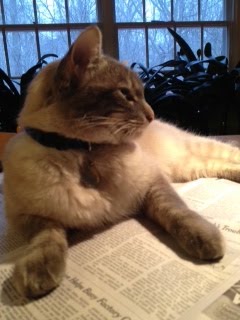
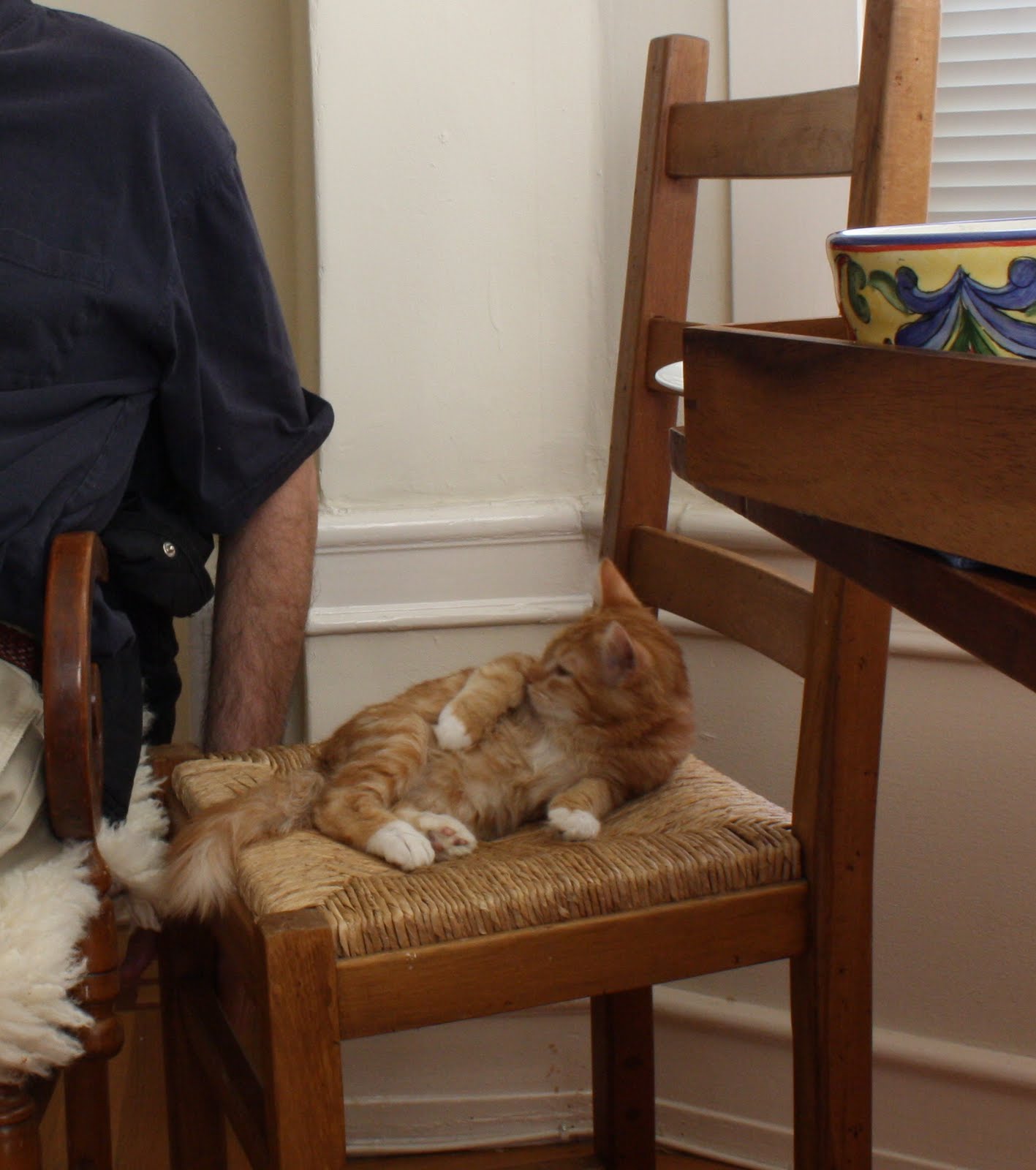
Back in the less politically correct turn-of-the-20th Century, there was a cartoon with the following caption: “Leading cause of adult illiteracy: CATS.” In our household, Zanzibar (pictured here “censoring” the New York Times) often makes it difficult to read All the News That’s Fit to Print. It’s fun to attribute to him the Jack Nicholson motive of shielding his lily-livered owners from the Inconvenient Truth.

Alas, as libel lawyers grow rich demonstrating every day, just cuz it’s printed don’t make it the truth, innit? [See all my previous posts under Murky Research, to bang home this observation.] Every morning I do a side-by-side comparison of articles in the NYTimes & Washington Post, which 2 “reliable sources” often use the same photo for a given story, yet recount Rashoman-like variations of the “facts.” Then I go online and use the Manchester Guardian as the tie-breaker, especially for reportage on American politics. As the not-untainted-erstwhile-NoW-editor, Piers Morgan, put it on Chelsea Lately the other night, the Brits don’t have “a dog in the race.” [A slightly more humane metaphor than the American “dog in the fight.”]

Yet, even if we are in a newspaper-free zone [like a hotel, where all they offer is The USA Today], our dear little heads do Zanzibar’s job for us. We edit incoming data heavily. We say to ourselves, “I don’t wish to know that!” and either block it, forget it, or distort it. The clinical terms for the first 2 defense mechanisms are denial & repression. The 3rd is called PR.

This morning Lili & I got to the sports park early enough that we had the place to ourselves. “Good-o!” thought I. “No worries about fraught encounters with other dogs. We’ll just enjoy the gorgeous morning.” We had completed half the circuit when we met a leashed terrier mix & his owner, so I put Lili in a down-stay to let them pass by. I was succeeding in being Lili’s Pack Leader, until the man asked, “How are you today?” When I replied, “Fine,” Lili sprang into action, dragging me across the path, so she could bark & lunge at the now-also-barking & lunging terrier, as I profusely apologized. Oy! Such humiliation I suffered! More than 7 years of daily training exercises, and I still can’t reliably control my dog. So, as we pounded the pavement even faster, to “burn off” my anger (and, possibly, Lili’s), I formulated a face-saving, fact-bending “press release,” for the next time Lili shows me up in public: “Sorry. She’s a rescue.”

Then I could imagine Jack Nicholson sneering & Zanzibar sprawling, and I pulled myself together. Amended press release: “Sorry. She’s a work-in-progress.” [And so is her owner.] I had just loaded Lili back up into the Jeep, when the terrier & owner reached their nearby car. He gave me a not-at-all-condescending wave [completely neutralizing any residual humiliation] and his terrier (perhaps noting that the fearsome wolf-like beast was safely locked up behind metal & glass) gave a farewell bark & lunge display.

The truth is, every dog & owner partnership is a work in progress. I think I can handle that.

Leave a comment

Filed under aggression happens, attribution theory, lesser of two evils

To "Lose the Plot"


So, here we are again, with 3 shooters (one, as I write this, “holed up but in talks” with the French police), for each of whom the media & the public are trying to arrive at a differential diagnosis: “mad” (in the British sense of the word, meaning: “crazy”) or “bad”? To cut to the chase, as usual, I think the more relevant distinction is between “mad/crazy” and “mad/angry.” But I digress.

Into this quagmire of Anglo-American failure(s) to communicate, I am tossing an old expression [to “go haywire,” from 1915] and a 21st Century one [to “lose the plot”]. Notice, if you will, my choice of the present participle, “tossing” [“used…to express present or continuing action or state of being” Webster’s New World Dictionary, 3rd edition]. When we say an individual “goes haywire,” or “loses the plot,” do we mean to say [pace Sir Bob Geldof] “the silicon chip inside her head gets switched to overload,” and stays in the Overload position? [Notice how cunningly Sir Bob, who knows his English grammar, for all he’s an Irishman, uses/used the ambiguous “gets”? Could be my least favorite tense, the historical present, or could be a recurrent thing that happens with this particular shooter’s brain every Monday, that her chip always gets switched. Nar’mean?] If you were born yesterday, you may not know that the song’s title, “I Don’t Like Mondays,” is the verbatim explanation that a real life school girl gave, for her shooting spree.

Americans who use the phrase, to “lose the plot,” mean [according to the Urban Dictionary], an individual got mad/angry about something and acted out aggressively. The Brits say “He’s lost the plot,” and mean that an individual has gone mad/crazy and is now acting erratically, posing a danger to self & others. Who knows if it’s “an on-going situation,” or it will clear up at sunrise?

Now, I shall use an animal metaphor [as I am always doing, not just this one time]. I was watching the steeplechase (hurdle jumping) racing from Cheltenham [UK] on HRtv the other morning, with my usual attitude of neutrality. “Let all riders & horses survive these grueling contests of attrition without major mishap,” I bid Poseiden. But, in two consecutive races [one for mares & one for male horses] several jockeys “came off” as they went over jumps. Unlike the Santa Anita flat races described in my last post, there were no outriders to wrangle the riderless horses. A few horses carried on jumping the fences, even though they had the option to avoid them and to “run on the flat” parallel to them, if they wanted to “stay with the herd” and cross the finish line. One mare seemed to “figure out” that she could make better time by going around the fences rather than over them; and she gave the front runner quite a challenge. If this had been a scene from a Disney-type movie [like Racing Stripes or Mary Poppins], it would have been easy to attribute the human motive to these riderless jumpers, that they “knew the mission and were going to see it through.” Even so, what was the “mission”? [What was the “plot”?] To jump every fence on the course, or to cross the finish line first? Which horses, then, had “lost the plot”? Or had they all “lost the plot,” when they kept on racing even though they had lost their riders? Cut them some slack, will ya? They’re horses. Herd animals. Born to run with their reference group.

What about these 3 shooters? [There may have been more by the time you read this. I am referring to the Staff Sgt. in Afghanistan, the vigilante in Florida, and the Algerian in France.] Each one of them has been described by those who “knew” them, as “not the sort of person to do such [aggressive] things.” Did they “lose the plot” and “go haywire,” or were they “wild” all along, but no one knew it? Well, folks, we all are. That’s the point of this blog. The specific “irritant” that “got up the nose” of each of these shooters [and led to their acts of aggression] may or may not ever be revealed to us; but it’s a salutary exercise to try to speculate about it. Human behavior is complex, but not inexplicable. To say that an individual “must have just snapped” or “gone haywire,” or [temporarily or permanently] “lost the plot,” is to explain nothing.

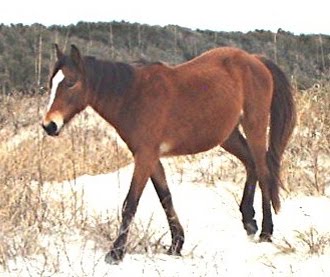
After all, these are human beings, not horses. Yet, even the actions of horses are complex [but not random, although we cannot always predict them]. The horse in this picture is one of the wild ones on the Outer Banks, photographed by my 90-something mother-in-law (something of a wild one, herself).

Leave a comment

Filed under aggression happens, attribution theory, ethology, semiotics