Yearly Archives: 2010

Who Says?


Not only is this a song title from John Mayer’s latest musings on interpersonal ambivalence, Battle Studies, it’s what all and sundry are asking and/or acting out, these days. “The peasants are revolting!” goes the old double-entendre, and so are Army generals, Hollywood starlets, and all the drivers who blow past me daily, on a narrow road clearly marked 40 mph and crawling with police. Sheesh!

In Ireland these days, such behavior would be labeled “bold” [as in “…as brass”], which no longer means brave, but just impudent, shameless, feckless, or insouciant. Is there more of this about, or am I just an old stick-in-the-mud? I blame reality TV, ya know, which gives viewers a false sense that the risk of legal sanction is outweighed by the prospect of fame [and, occasionally, fortune]. Back the the 70s in Manhattan, some of my acting school friends who didn’t have day jobs would audition to be contestants on a quiz show called Jackpot! To make the otherwise boring show watchable, the talent-spotter rewarded the most over-the-top, crazed members of the studio audience by choosing them to [the uncopyrighted equivalent of] Come On Down, and play the game. They shot 5 “episodes” of the show in one day, so the semper paratus acting student bought a hold-all with 4 other shirts, just in case. One of our friends got selected for bellowing “Crackpot!” instead of the show’s catchphrase. He used the video of his 5-show “performance” [during which he “chewed the scenery” shamelessly] as a cheap & cheerful audition tape for the consideration of various theatrical agents; and it got him work.

These days, in the lyrics of the Scouting for Girls song, “Everybody wants to be on TV.” As an erstwhile student of Sociology, I could make a connection between the dearth of actual Day Jobs, and the fantasy of “quitting [one’s] Day Job” (to become rich & famous); but it’s belaboring the obvious. My actual point is a more universal, psychological one. If virtue [observing the speed limit, graduating from college, obeying one’s Code of Conduct] is not rewarded, it is less likely to occur. In situations where the fear of punishment for Engaging in Shenanigans is outweighed by the humiliation of having Done the Right Thing and still gotten a Bad Outcome, stand by for more Shenanigans.

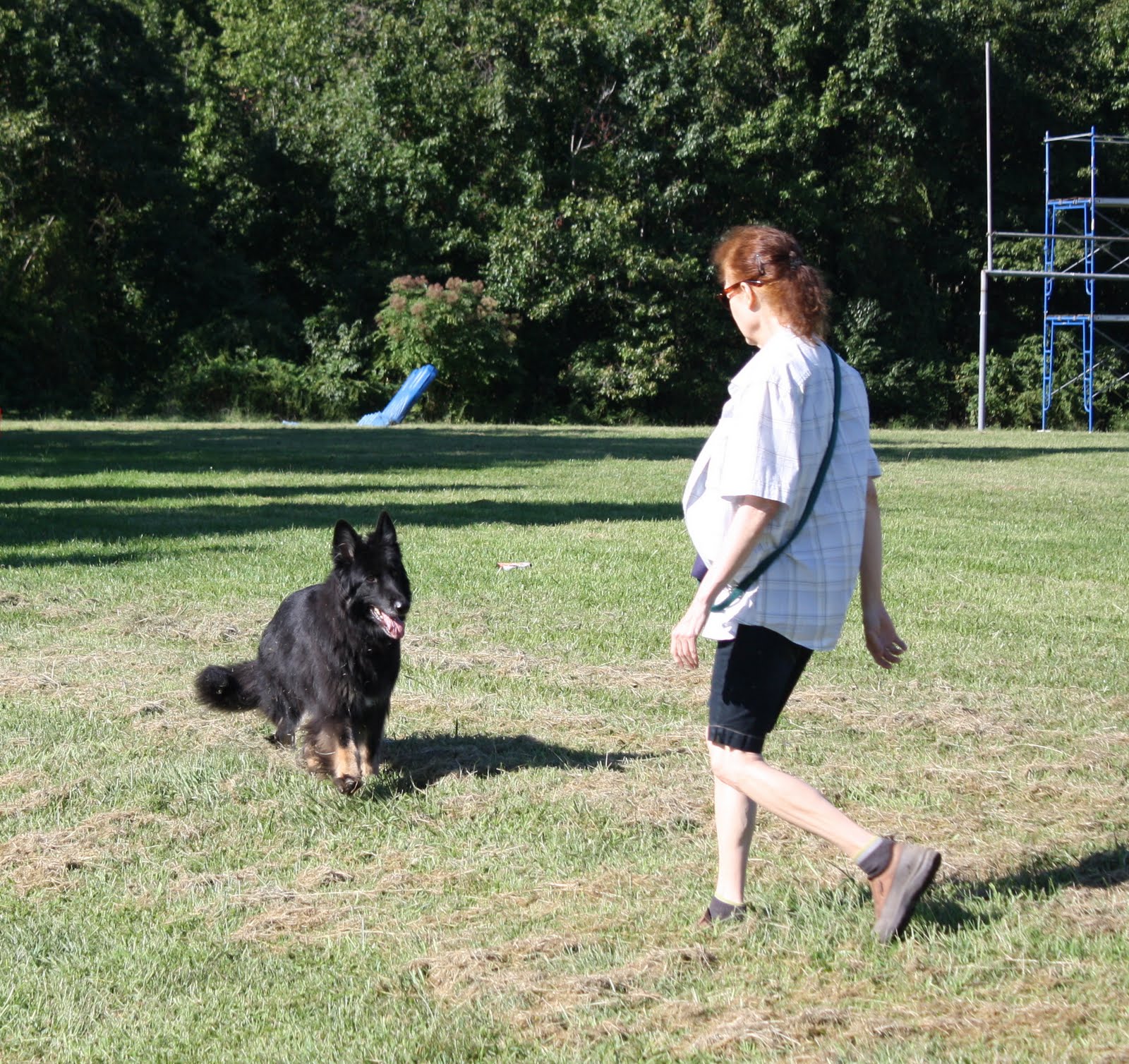
This is Lili, boldly ignoring my command to jump over a barrel to my right. Although it is high summer again, the picture is from 2 years ago, before we had truly appreciated that You Get What You Reward, and You Reward Disobedience by Letting It Slide. Silence gives consent. These days, this seemingly trivial moment of noncompliance would be met with, “Oooy! Ali Oop!” followed by a heartfelt “Yosh! Ichibon Inu!” [Good! Number One Dog!] as she completed the jump. Not a contract for her own reality show, mind, or even a high-value treat. What Lili and the rest of us need, to keep on doing the dorky Right Thing, is for our masters to notice, and acknowledge, our efforts.

Leave a comment

Filed under lesser of two evils, understanding shenanigans

"Wild horses…"


What? “…couldn’t drag me away” [Richards & Jagger, 1971]? Well, of course they couldn’t, or more accurately, wouldn’t, you City Slickers, cuz they is wild, innit? They neither bear weight on their backs, nor pull it via harness. Their theme song is, “I’ll Never Be Your Beast of Burden” [Richards & Jagger, 1978]. What they will do, if you intrude into their established territory, however, is charge you and possibly trample you.

Which is not to say that they run amok, or obey no Code of Conduct, according to the equine ethologists who study them, particularly the band of 250 [wild horses, not ethologists] who live on Cumberland Island, Georgia. The observers note that the horses tend to organize themselves into Family Groups [a stud, his mares, and their offspring], who rotate through the various grazing venues on the island: meadows, marshes, woods, and beach dunes. An anthropomorphic explanation of this nomadic behavior might be that the families are altruistically sharing the nutritional wealth of the island with their equine brethren. There are two flies in that Utopian ointment, though. One is, well, flies. Inland, where the grass is lush and plentiful, the horses are tormented by flesh-eating flies; whereas on the shore, where the sparse, tough dune grass grows, the constant sea breeze blows the flies away. So perhaps [as Harris opined in Cows, Pigs, Wars & Witches] local geography shapes what is considered to be The Right Thing to Do. [In this case, to keep hoofing it, to the next ambivalent stand-off between eating well and being “eaten alive.”]

Also, as in most human cultures, there is an Out Group, who are forcibly excluded from the Happy Families scenario: bands of Bachelor Horses. The observers offer an illustrative vignette, in which a bold Bachelor Horse put just one hoof onto the territory of a Family Group, which was marked by what is euphemistically called a Stud Pile [of dung], and was immediately charged by the stallion and “shown off the property.” Insert your own current human example of such behavior here. It is not clear [Is it ever?] how the hapless members of the Out Group drew the short straw. What is inspiring is that, every so often, a pariah horse bravely challenges the authority of the humiliating and/or fearsome studs.

Speaking of inspiring, this photo of two Bachelor Horses was taken by my [90-ish] mother-in-law, who trudged 10 miles down the beach to find them, yet [uncharacteristically, for her] heeded the warnings of the island guides, to keep a respectful distance away from her subjects, lest they “pass on the pain” and trample her. Having got what she came for, she trudged the 10 miles back to rejoin the Band of Ecotourists, of whom she & my father-in-law were the oldest by several decades, though not made to feel like members of an Out Group, for all that.

Leave a comment

Filed under ethology, power subtext, zero-sum-gaming

Feeling Threatened?


Back in the day, before the advent of the Homeland Security Advisory System [as in “A day without Orange is like a day without sunshine.”], there were other semiotics for indicating that it was time to “Be afraid. Be very afraid.” There were the DefCon levels, whereby [counter-intuitively], DefConOne betokened Doomsday, whereas DefConFive was the Peaceable Kingdom. Since most non-combatants thought it was the other way round, it wasn’t all that useful as a civil defense advisory. In my Naval family of origin, we used the traditional “Go to General Quarters” to signify that we were in crisis mode.

But, whatever you call it, your limbic system usually gets there way ahead of your pre-frontal cortex; and you are already engaging in a [possibly ill-advised] Fight, Flight, or Freeze response, “before you can say knife” [as the English measure it, as compared to the American “say Jack Robinson” unit of time]. Absent an airport Tannoy announcement, what cues the threat response? For most of us warmblooded creatures [including, as usual, Lili the dog], it’s the fur on the back of our neck standing on end. This is most amusingly obvious with cats’ tails puffing out, of course. Yeah, yeah. That’s what I’m saying. In the dualistic parlance of the Mind/Body dance of anxiety, it’s usually the body that leads. [You can search-engine iconic studies from the 60s involving the IV administration of adrenaline, the physical effects of which “undergraduate volunteers” (an oxymoron) were “contextually manipulated” to interpret as either fear or excitement.]

Other physical changes include pulse and respiration rate, as well as increased muscle tension. Those of us in the business of devising ways to “smooth ruffled feathers” often resort to reverse-engineering tactics. Big Pharma, and brewers before them, recommend skeletal muscle relaxants: “How dire can things be, if I’m feeling this loosey-goosey?” Despite the risk of inconvenient side-effects [DUIs, addiction, or respiratory collapse], ya gotta admit, the euphoria that comes with chemically-induced muscle relaxation really beats being told, “Oh, relax!” by an unsympathetic companion. We Mental Health providers try to suggest alternative routes to tranquility: yoga, meditation, progressive muscle relaxation exercises, hypnotic trance induction… “Too New Age-y” complain the uptight. “I can never remember my mantra in a crisis.” So, I try to reverse-engineer the shallow breathing: “Sing!” I command. “Whistle, if you know how!” [Remember my post on Bridge on the River Kwai? The ditty the POWs whistled in the face of their implacable captors, “Colonel Bogey’s March”?] Besides sublimating fear with an inside joke against the enemy, whistling (like singing and humming) normalizes breathing. It is what Behaviorists call an Incompatible Behavior (with the panting that accompanies anxiety).

Recently I have found that singing to Lili is as effective for “standing her down from General Quarters” as the Freeze commands to “Lie down” and “Stay down” are. She just can’t resist coming over and singing along. [It may have to do with the overtones I produce.] Another explanation is that my carefree singing lowers her level of perceived threat: “How dire can things be, if my Pack Leader is so loosey-goosey?”

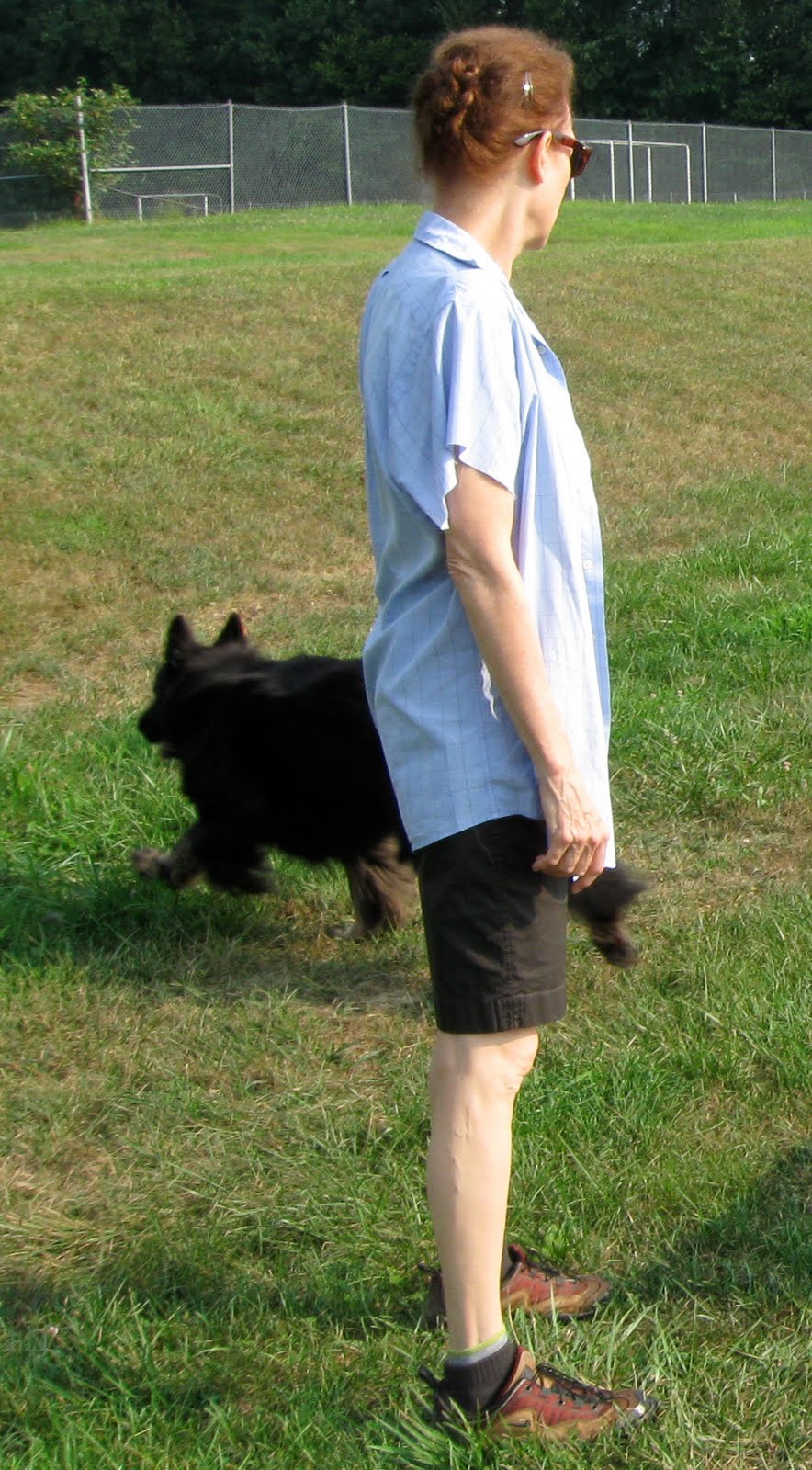
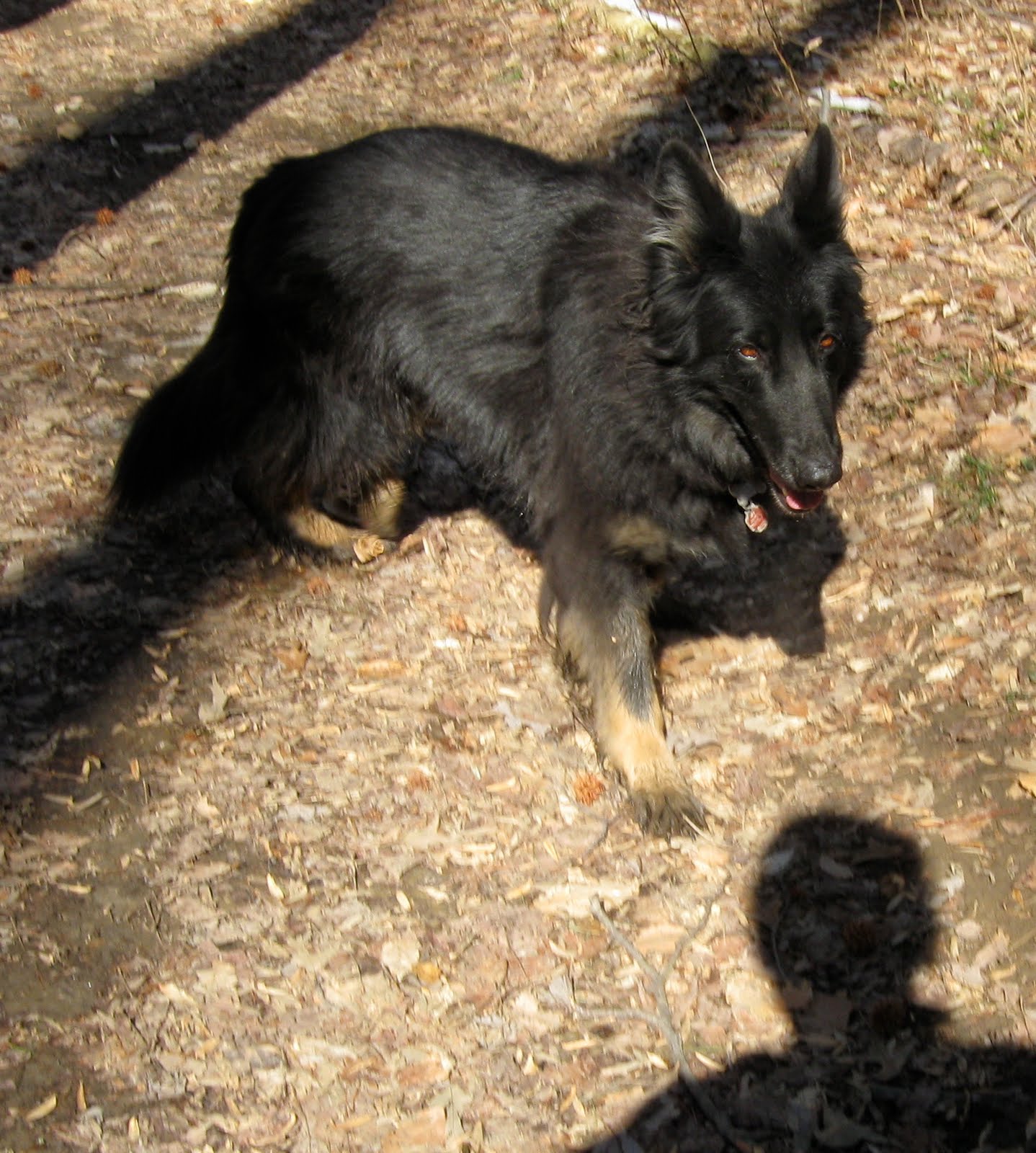
So, in this picture, is Lili a threat, or threatened? [Well, in the event, neither, since the shadow is cast by her trusted Pack Leader.] But if she were confronting a stranger, the correct answer would be “both.” Next time you encounter a dog who’s “going to General Quarters” [or find that the Wolf in Your Head is howling], you might try a little musical reverse-engineering, yourself.

Leave a comment

Filed under aggression happens, limbic system, semiotics

The Hoon Report


Thanks to the personable young British Formula One racer, Lewis Hamilton [whose shenanigans in his Mercedes-Benz AMG C63 “road car” two days before the Australian Grand Prix cost him a slap-on-the-wrist fine of “just under 300 pounds” for “acting like a hoon”], those of us in the Northern Hemisphere have learned a new epithet, that we can hurl at “aggressive drivers” who set off our limbic system alarms with their risky moves. Mystery shrouds the derivation of this Antipodean term [which originally referred to any “young person who engages in loutish, antisocial behavior,” but has more recently become a “semi-official term” for street drag-racers, as in “Australia considers anti-hoon legislation”]. I have two theories. One, that “hoon” is merely a contraction of “hooligan.” Two, that it comes from the objective case of the Gaelic word toin [as in the Irish imprecation, Pog ma hoin], and so originally meant “ass.” [As in “Quit acting like a hoon, you silly ass!”] Not all that farfetched, considering that the First Wave of “immigrants” to the Land Downunder were predominantly Irish. [If you don’t get the quotation marks in the previous sentence, look up meaning 4 of “transportation” in Webster’s, innit.]

Anyway, here is Fionbharr [Finn to his friends], a San Francisco rescue, to keep not-so-solipsistic-Seamus company in the new place. If Finn were, indeed, writing a blog, it would seem to be coming right out of his hoin, now, do you see?

Back to Hamilton, though, who serves as Formula One’s “ambassador for [its] global road safety campaign and has given speeches in Westminster [Parliament] on the subject.” Through his lawyer, he issued a statement to the Australian court [and the rest of us], that he had suffered “embarrassment, humiliation and distress as a result of the episode.” We’re going to consider if Hamilton has truly “owned his wolf” in a moment; but here’s how it played in court. “Magistrate Clive Alsop said he would not convict the 25-year-old because he was ashamed and remorseful. However, he added that Hamilton’s behavior was unacceptable. ‘This isn’t about somebody’s character, this about somebody in a responsible position behaving like a hoon.'”

But, do yah see, now, Magistrate Alsop, in my book [well, blog], “character” is exactly what this is about? It’s all very well to acknowledge that having one’s car impounded two days before the Oz Grand Prix is “embarrassing, humiliating, and distressing.” That’s being sorry you were caught. It does not address the question: “What got up my nose, that I decided to violate the rules of the road [and the core values of the road safety campaign for which I am a high-profile spokesman]?” As with all the grabbed-from-the-headlines cases I cite, I realize that once the accused has “lawyered up,” the odds of such public self-disclosure lengthen considerably. But we, the mere readers of the story, can ask the up-your-nose question on their behalf [and vicariously, on ours]. For unless “out-of-character” behavior is understood, it is likely to recur.

As with the ponytaail-yanking soccer player in the post “In Hindsight,” perhaps the question does get asked and answered, in private, after the news media have cleared off. Having served a 2-game suspension, that young lady is back playing for the Lobos. Maybe she has done her “wolf work,” and has figured out how, in that aggressive sport, to avoid acting like a Red-Card-level hoon.

As for my boy Hamilton, he won the Belgian Grand Prix yesterday, by “driving safely and keeping out of trouble.” Even though Chris Rock laments that “There is no rehab for stupid,” there may be rehab for acting like a hoon. Let’s hope so, anyway, since we’ve all been there, if we’re honest with ourselves.

Leave a comment

Filed under jekyll and hyde, understanding shenanigans

Working on a Clear Round


Those of us who have watched our share of televised equestrian events tend to put the sound on “mute,” to avoid hearing this inane, now-you’ve-jinxed-it phrase, which seems to guarantee that horse & rider will knock over the next fence. In the first place [where this “doomed” equine/human team are now not likely to finish], why state the obvious? It’s not a radio broadcast. Anyone who cares about the outcome of the event will be able to work out if all the jumps have remained up so far, or if some rails have fallen. It’s not a judgment call. As for time penalties, there is usually a graphic in the corner of the TV screen, keeping track for the viewers [but not the rider, who has to make an elaborate, on-the-hoof compromise between haste & accuracy, to win this zero-sum game].

Okay, so horse people are “a breed apart,” notoriously superstitious; but so are theater folk. It’s bad luck to wish an actor “good luck” before a performance: hence, the Poetic [as in, “I mean the opposite of what I’m saying”] phrase “Break a leg.” In the UK it’s bad luck to say “Macbeth” [especially if that’s the show you’re in]: hence, “the Scottish play.” My favorite line from the 1947 musical comedy send-up of Irish-American folkways, Finian’s Rainbow, is “Don’t be superstitious! It’s bad luck!”

So, that’s my excuse. I’m a horse-loving, theatrical, Irish-American. What’s yours? Cuz everyone is superstitious about something or other. Black cats? Friday the 13th? Announcing that you’re expecting a baby before all & sundry have guessed, anyway? This latter, culturally supported taboo falls squarely in the “working on a clear round” category. It avoids an air of hubris; of “pride goeth before a fall”; of “counting your chickens before they’ve hatched” [as it were]. We all remember that obnoxious student in high school, usually [not always] a girl, who after every test would set up a caterwaul of doom: “Oh, I just know I failed it!” And the rest of us just knew s/he got an A, maybe even the highest grade in the class, and were less than sympathetic with this ritual of “needless” worry. Ah! But it does not seem needless to the hand-wringer [any more than compulsive hand-washing seems optional, to the compulsive hand-washer]. It is a magical, albeit Highly Inconvenient, attempt to counter the fear of Bad Outcome. Sometimes, as in the post-test-hand-wringer scenario, it is an attempt to counter the anticipated humiliation of getting anything less than a perfect score.

However, and this is the point, these little anti-hubristic peregrinations most of us indulge in are the lesser of two evils, compared with not trying at all. One summer day, while riding hired horses through the Vienna woods, my elder daughter & I overheard our guide ask her young son, “Max, bist du brav? ” [which we took to mean, “Are you brave?” but Cassell’s dictionary translates as “Are you well-behaved, a good boy?”]. Then she directed him & his mount to jump a newly-fallen tree trunk, which they did, after a few false starts, much to everyone’s delight [and our relief]. Now, when we are facing a daunting challenge, where the odds of success seem long, we ask each other “Bist du brav?” If what it takes, to be brav enough to put all our effort on the line, is a bit of “aw, shucks, I probably will make a dog’s dinner of this” lowering of expectations, than so be it.

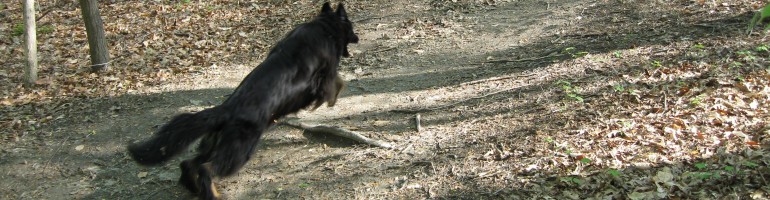
Whatever helps you to take that leap. [Incidentally, this is the fallen tree described in the “Timber Wolf” post.]

Leave a comment

Filed under crazy like a fox, lesser of two evils, magical thinking

That "Frenemies" Thing


Well, stone the crows, all these years I have been attributing this zero-sum-gaming motto to Gore Vidal; but now I find it, in a 1966 TIME magazine article, falling out of the gob of the hugely successful Broadway producer, David Merrick: “It is not enough for me to succeed; all others must also fail.” How humiliating, to have gotten it wrong! (Although I’m not alone. Others have credited Attila the Hun or Genghis Khan. Do I hear a nomination for Machiavelli?) The article, incidentally, in that halcyon, less in-your-face-snarky era of journalism, was called “The Be(a)st of Broadway,” geddit? Cuz, Mr. Merrick was (ahem) ambivalently regarded by the theatrical community.

Now, a short diatribe on the clinical meaning of “ambivalence” (as opposed to the “street” meaning, of “I hate his guts!”): “simultaneous conflicting feelings toward a person or thing, as love and hate” [Webster’s, 1988 ed.] Not, “as fear and loathing,” nar’mean? To illustrate this point in therapy sessions, I hold out my hands in the “supplicant palms” position, and intone, “On the one hand, ya-dah-ya-dah. On the other hand, la-di-dah.” I then say, “There are very few things or individuals in our lives, about which we humans are not ambivalent.”

Oh, but how we hate to admit it! Even to ourselves. So, hurrah for the new portmanteau word, “frenemy,” which captures the both-hands [simultaneously positive & negative] feelings which we can sense in others [but only bald-faced truth-tellers, like Merrick & Vidal, will acknowledge in themselves]. We’ll know that this brave willingness to admit to ambivalent feelings, about even our Nearest & Dearest, has made it into mainstream consciousness, when “to frenemy” someone becomes a transitive verb in Facebook parlance.

The next post will deal with the ways people avoid Owning their Inner Wolf [as in, acknowledging that another’s success can stir feelings of humiliation that they got the “prize” we wanted, and even fear that there won’t be enough “prizes” to go around].

Meanwhile, here are Seamus & Finn, locked in some sort of close contact. Is it a hug or combat? That’s easy. It’s both.

Leave a comment

Filed under ambivalence, zero-sum-gaming

A Pot & Kettle Situation


Our theme today is Freud’s charging horses, back at the Spanish Riding School in Vienna. They of his hypothetical question, “Would you rather be pulled apart by two horses, or charged by two horses?” To be less Poetic and more Metaligual about it, we’re talking the defense mechanism of projection. Here are some of Ray Corsini’s definitions [in The Dictionary of Psychology, 2002]: “attributing to others what is actually true of the self, often used to justify prejudice…the process by which impulses, wishes, or aspects of the self are imagined to be located in some external object.”

Thus, the premise behind Projective Tests is that the subject will see in ambiguous visual stimuli, unconscious aspects of himself. You may recall from an earlier post that, unlike most “subjects” who think Lili looks like a wolf, a municipal workman thought she looked like a bat. Two more recent “responses” [as they are called on the Rorschach]: this summer a general contractor for the school, taking smoke breaks in a shady passage to the playing fields, would routinely greet Lili with, “There’s my bear!” More bizarrely, a middle school boy, rambling in the woods with his science class to collect leaf specimens, asked “Is that a mountain lion?”

Instead of the deadpan “yes” I gave him, I could have said [in my best Cockney accent], “Oooh! Talk about the pot calling the kettle black!” but that archaic expression has long since been shortened to the title idiom. It would have been an obscure joke, anyway, like the recurrent SNL sketch where two dorky Bostonians keep saying, “No, you ah” to each other. But that’s what projection is: saying “No, you ah” to the “charging horse,” rather than owning the “wolfish” aspects of oneself. Remember the middle school retort, to being called something negative [like a bat, or a bear, or a wolf, or a mountain lion]? “Takes one to know one.”

Well, precisely. That was Freud’s point. Well spotted, you middle schoolers and SNLers! Be a detective of human nature with me, and notice, on any given day, who is screaming the loudest imprecations against the “despicable” behavior of his/her foes. Wait one news cycle, and behold the hideous portrait [or skeleton] hidden in said screamer’s own closet.

Less fun, but more to the point, we might ask ourselves why a friend’s or relative’s Highly Inconvenient behavior is Driving Us Howling Mad. Whatever else is “up our nose” about their shenanigans, there might just be a whiff of humiliation, as we grudgingly recognize in our own sweet selves a similar impulse to be beastly.

Leave a comment

Filed under attribution theory, Freud meant...

"Dai-jo-bu!" ["Everbody cut footloose"]


Where would the business based rom-com [from The Pajama Game to MadMen, which, don’t kid yourself, is a comedy, whatever its Emmy category] be, without the office party, or better yet, the off-site office picnic? Nowheresville, that’s where! (Hold that thought.)

How do drug/bomb/corpse-sniffing dogs learn their trade? Through rewards for accurate scent detection, sure; but what’s the most commonly used reward? Why, play time with the “Boss.”

In the Navy, we mice learned at “salute school,” there are 3 basic postures, in the presence of the Boss Cats: “Attention on deck” [stand up straight, “eyes in the boat,” and don’t move]; “At ease” or “Fall out” [you are free to mill about smartly]; and (for me) a useless middle-ground position, because it was less comfortable than standing to attention [hands folded at the small of one’s back, as if handcuffed] “Parade rest.”

Lili’s trainer [a former Marine] taught us to tell her “Zen-zen” [literal translation, “Never”] for the “Don’t move” command, which we were encouraged to extend, for distance and duration, as we left her in the “Down/stay” position in an open space. The release command, “Dai-jo-bu!” [literally, “All right!”] is more festive than merely “At ease,” or “Fall out.” It means “Party time!” It’s an exhortation to “cut footloose,” to do a little dance of joy, to “play with the Boss Cat,” not just to follow orders.

And therein lies the conundrum. In the Navy, a junior officer used to parse a “command performance” [an “invitation” to a social event that one could not refuse, without negative consequences], using a Germanic funny voice, “You will come! You will enjoy it!” So, too, do some reluctant attendees to the company party/picnic mutter to themselves, “Aye, aye, sir. Three bags full, sir. It’s not ‘play’ if it’s required, no matter how much booze is on offer.” The well-meant but ham-fisted proclamation of the Boss Cat(s), “Let the revelries begin!” is experienced as an intrusion into one’s private time off. Worse, if one “befriends Ethyl” [gets drunk] to get through the event, one risks humiliation or even the fear of the Boss Cats’ displeasure.

So, what’s the upside of such jollifications? Well, believe it or not, they work best if the captive merry-makers are divided [randomly] into teams, to compete in a bit of low-stakes zero-sum-gaming [ranging from silly, pseudo-athletic events to charades and Trivial Pursuit]. To promote the “We’re all in this together” spirit, the Boss Cats have to muck in with the mice [at least one per team], thereby showing what Jolly Good Eggs they are, really. To encourage reference group cohesion, each team should devise a clever name for itself [not necessarily by democratic means]. If all goes well, the use of the Poetic Speech function [jokes, plays on words, mimicry, and general Mick-taking] will increase, and laughter will follow. Stress will decrease. Cortisol production will be slowed.

The “play drive” in dogs has long been recognized and used strategically by their Boss Cats, to increase on-duty “productivity.” [“All work and no play makes Jack a burnt-out, distracted dog.”] It is also a powerful motivator in humans, as taught in Management Courses for Boss Cats. No matter how deadly serious the mission we’re on, inside of each of us there is a Party Animal, waiting for a moment of comic relief. Waiting for the release command, “Dai-jo-bu!”

Leave a comment

Filed under comic relief, reference group, stress and cortisol

"Softly, softly…"


“…catchee monkey,” goes a proverb so old that its origin is anybody’s guess. Early 20th Century Britons assumed it came from somewhere in Asia [China or India, somewhere with free range monkeys, don’t you know]. It means, “You are more likely to catch a fugitive (thought or creature) by guile, than by charging at it directly, all guns blazing.”

My absolutely fave UK telly show in the early 60s was Z Cars, a cop show, wherein the Baddies were pursued by pairs of what are now called “gavvers” in unmarked Ford Zephyrs [whence the show’s name]. Car chases took a back seat to good character acting, some of it undoubtedly improvised, since the shows were broadcast live. By 1966, our heroes had been promoted to detective status, and appeared in a new show, Softly, Softly. All subsequent cat & mouse, “I’ll trick the truth out of you, Clever Clogs,” police procedural shows owe a debt to these 2 series.

One of these, The Bill, ran from the 80s right up until this year, when its producers decided (gasp!) that the story lines were becoming repetitive and predictable! Give over! That’s part of what we all loved about it. In its first decade there was a dour young Scottish detective who, in every episode, to signify that the villain was now ready to “cough” (confess), intoned, “In your own time…”

Which is the point of this post. “Ticking bomb” scenario or not, centuries of clinical experience and modern neuroscience agree: “You can’t hurry truth. You just have to wait.” Remember how Ronald Reagan excused his filmography of grade-B movies: “The studio had us on a tight schedule. They could have it good, or they could have it Tuesday.” Same thing when it comes to actionable intel. We can, by word or deed, exhort the (putative) Bad Guy to “Spit it out!” and get a quick (possibly false) confession; or we can “go all round Robin Hood’s barn” and catch him up in his own tangled web of lies.

The same choice of strategies applies to our own attempts to recover a fugitive thought. No matter how vital a piece of information may be, if we “rack” our brains for it [as in “Nobody expects the Spanish Inquisition!”], we redirect blood away from the hippocampus [the site of memory & problem-solving] to the amygdala [site of “OMG!”]. In academic settings, this is called “brain freeze,” or “an attack of stupid.” Like coaxing a skittish monkey [or dog] across a rickety footbridge to our side, we are likely to get better results with a “softly, softly” approach. Like the Scottish detective, we might try acting less humiliatingly desperate to get our uncooperative brain to “cough” the crucial but elusive intel, and instead intone, “In your own time…”

Leave a comment

Filed under ethology, limbic system

"Dig it"


“…like the FBI, and the CIA, and the BBC.” So goes the Beatles’ shortest song, from the 1970 Let It Be album (now available for legal download on iTunes). Beat musicians had been saying “Can you dig it?” or “Ya dig?” for decades [the American version of “nar’mean?”], to ask “Do you understand what I just said?” but by the time the Beatles used it, the phrase had morphed from the Metalingual [message clarification] speech function to the Phatic. It had come to mean “Listen” [as in “do you want to know a secret?”]

Well, do ya? [Want to know a secret, that is.] In the 60s, Daniel Ellsberg was convinced that we all wanted to know the contents of secret briefing papers on strategies for vanquishing North Vietnam [thereafter known as The Pentagon Papers]. So he dug up some classified information and gave it to the press, for all us quidnuncs to read.

La plus ca change, la plus ca meme chose. Nar’mean? Julian Assange? WikiLeaks? Ya dig?

Guess who thinks Mr. Assange is a swell guy for sharing with the whole [cyber-linked] world the classified information he was able to dig up? Why, Mr. Ellsberg, of course.

Whether you do, too, depends on your reference group. Are you more “The truth will set you free”; or more “Loose lips sink ships”? Far be it from me, to try to get you to switch groups. None of us can predict the effect of the WikiLeaks disclosures on global security. I’m more curious about the precursors. [As in, what got up Assange’s nose, that he decided to crack the code of encrypted websites and report his findings?] Mind you, that’s the basic mission statement of those who work for the FBI, and the CIA, and the BBC.

Our [often fear-based] Need to Know What’s Happening is the key to our individual and collective survival. Curiosity saved the cat, the dog, and us. We all “want to know a secret,” but we don’t all “promise not to tell.”

Leave a comment

Filed under phatic communication, pro bono publico, reference group