Category Archives: limbic system

Move It or Lose It


How’s this for a high-concept article title? Not mine. This one, hot off the press from the Proceedings of The National Institute of Sciences: “Running enhances spatial pattern separation in mice.” A research team headed by David J. Creer in Baltimore & Timothy J. Bussey @ Cambridge University studied adult mice [3 months old] and “very aged” mice [22 months old]; and determined that adults with nifty, blue plastic, saucer-shaped exercise wheels in their cages [which they ran on, for up to 12 miles a day] enjoyed “synaptic plasticity and hippocampal neuro-genesis,” and could do a touch-screen task [to “find Waldo,” as it were] much better than their “sedentary” comrades.

Sadly, exercise for the aged mice did not significantly improve their task performance, mainly because they couldn’t quite grasp what the cockamamie task was, in the foist place! Still, a little run on the wheel, what could it hoit? [Why I’m giving the alta cocka mice Brooklyn accents is anybody’s guess, since they were actually living in “Bal’m’re”–don’t feign incomprehension, those of you who have watched every episode of The Wire–hanging out at the National Institute on Aging.]

So, let’s extrapolate the findings [the way the BBC news release did] to humans. It may be that, not only is vigorous exercise good for “tying down cognitive Kangaroos” [so that they can sit still and focus long enough to learn stuff]; it may actually encourage the growth of new brain cells in the hippocampus [thereby benefiting both Kangaroos & Clydesdales].

Gives a whole new meaning to the term Scholar/Athlete, no?

Now, here’s what I propose for a follow-up study. Let’s re-test those 3-month-old smarty-pants rodent/athletes when they are 22-month-oldsters; and see if they retain their brainey-ness. How very cool it would be, if they did.

I wonder what the human equivalent of 12 mice-miles a day is…

Leave a comment

Filed under born to run, limbic system, murky research

Caged Beasts


Even if you don’t live in the DC area, you are no doubt aware that we here are waay past “Winter Wonderland,” and into “Wonder When It Will Ever End?” Let me count the ways this heinous weather pattern has gotten up all our noses. Intrusion: we are all under house arrest today, no matter how many hours we have already spent shoveling our driveways. Fear: as the howling winds threaten to blow our tall, spindly trees onto our house [and maybe even our heads]. As I write, we have so far been spared loss of power; but thousands have not, and are already enduring the pain & suffering of no heat, no light and [here in the countryside] no water. But, as usual, it is humiliation that seems to have turned the area’s no-ruder-than-most drivers into what-are-they-thinking-damn-the-torpedoes-full-speed-ahead suicidal/homicidal maniacs. As today’s [soggy] Washington Post Op-Ed article put it, “The snow has fallen, and the flakes are on the road.”

Unlike folks in, say, Michigan, who have grasped through years of trial & error [and no-fault collisions], the humbling fact that 4-wheel drive vehicles are not laws-of-physics-defying Batmobiles which can overcome anything Mother Nature can dish out, these Mid-Atlantic road warriors…have not. Yesterday, for a change, it wasn’t even actively snowing; and I witnessed 3 harrowing collisions, not to mention many flip-overs, all involving SUVs. They “didn’t spend all that money on an ‘all-weather’ vehicle, to wuss around at half-speed just cuz of a little snow!” It’s loss of face they can’t abide, not loss of traction.

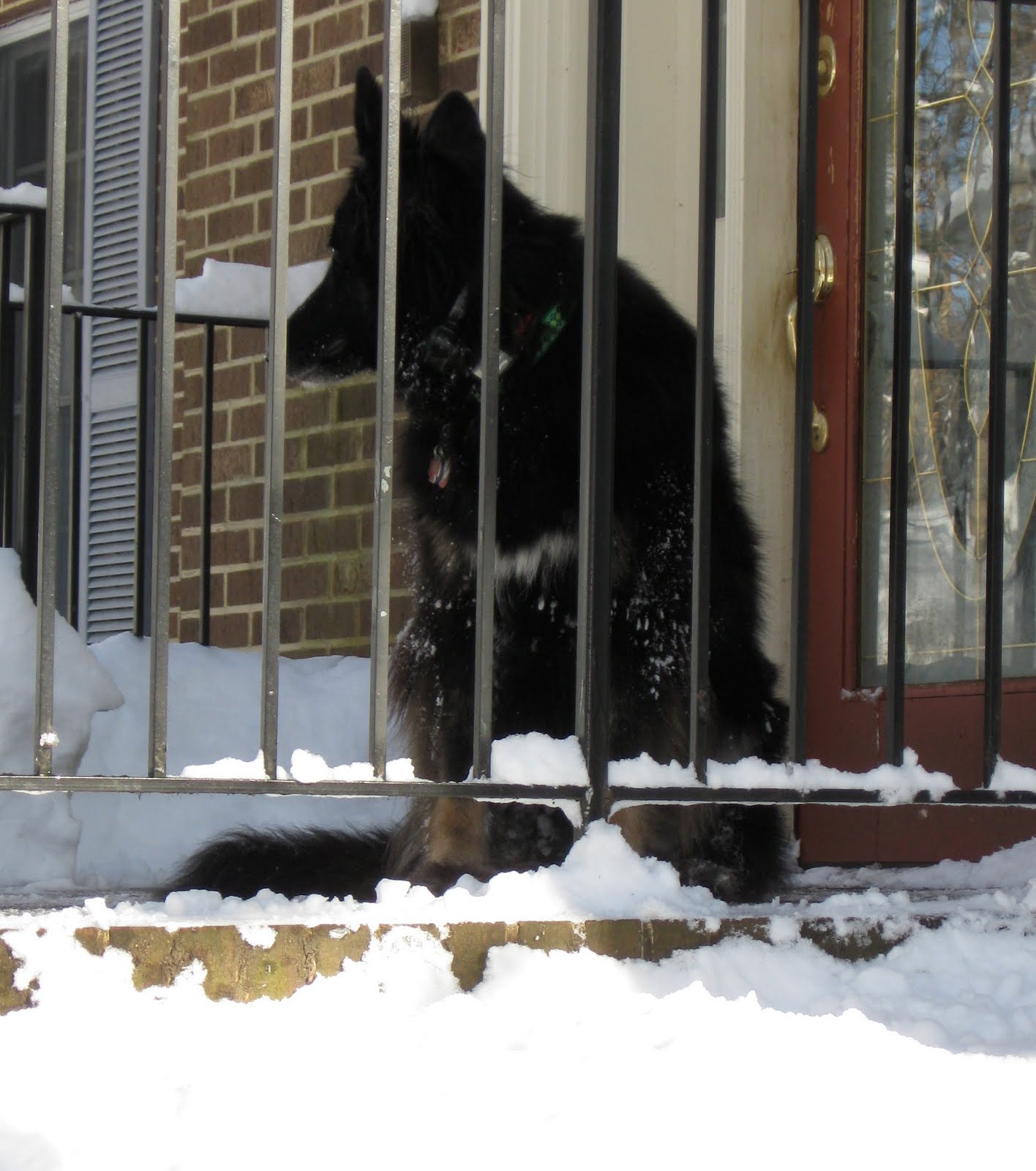
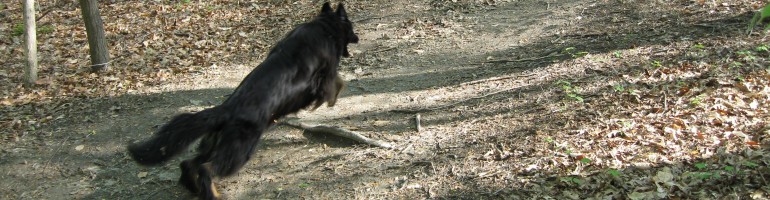
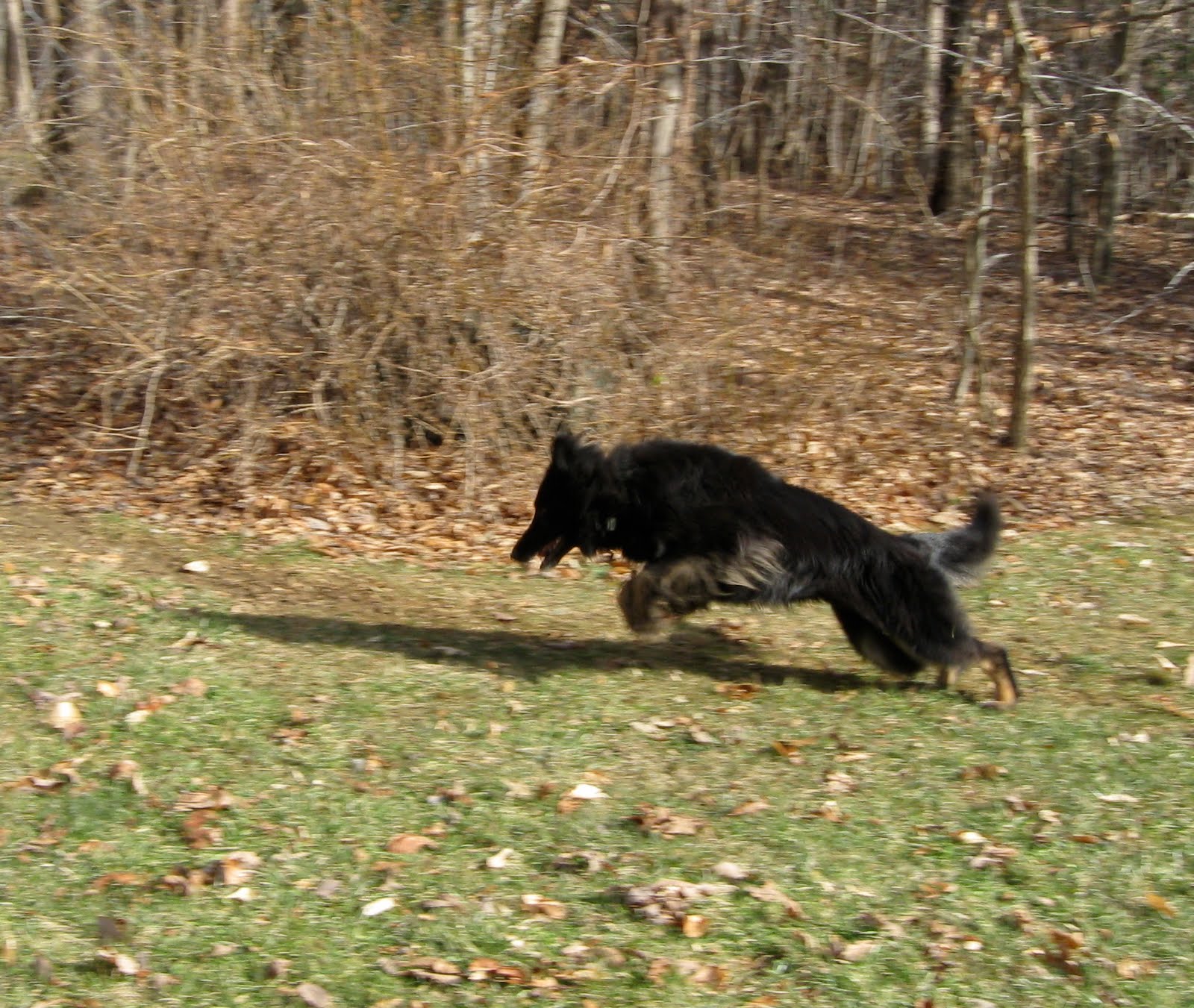
Meanwhile, this Winter of Our Discontent has taken its toll on Lili, who is used to her daily one-hour constitutional, featuring brisk trotting and exuberant running. Chris & I found one plowed section of road on the school grounds [about 100 meters long] over the weekend, and ran her to-and-fro between us like a yo-yo, commanding her, “A so ko” [over there] and “Oy i [d]e” [come to me], until [like the old mare, Dusk] she slowed to a walk. No such cleared road exists in our county today, however, so it’s plow through the 4-ft-deep snow in our yard, or pout on the porch, for our caged beast.

So far, I must say, she has maintained her “good sense, good judgment and self-control,” better than most of the snow-bound humans around here have. [I figure, it’s because she is dealing with less humiliation, innit?]

Leave a comment

Filed under born to run, gets right up my nose, limbic system, stress and cortisol

"Stuck in a Moment"


This meditation on the U2 song, which David [“Bono Vox”] Hewson has called an after-the-fact, imagined suicide intervention for his late friend, INXS frontman Michael Hutchence, is dedicated to everyone who has developed a de novo case of Seasonal Affective Disorder this winter. [More snow forecast for this evening in the DC area, tra-la.] It is also about the Gestalt psychologist Karl Duncker’s concept of functional fixity, which Corsini defines [in The Dictionary of Psychology, 2002 ed.] as “the opposite of…creative thinking.”

Consider the not-awful-just-highly-inconvenient intrusion of this prolonged spate of foul weather on Lili’s customary, daily ramble-in-the-woods. Until this weekend, the snow in the forest has been up to 3 feet deep, swallowing up the feet [and legs] of all but the snow-show-clad. The first time this happened to me, I was alone with Lili, who was off-leash but skittered over on the frozen surface, merely to bark her encouragement [impatience?] at me; and I began to fear that I would be Stuck in the Moment until the Spring thaw.

Resisting a $100 investment in snowshoes, I began searching for alternative venues for Lili to run, which were both [relatively] safe & legal. When school was canceled, the plowed parking lots were viable, except for some tricky, hard-to-see patches of ice. A couple of days we slogged through 2 feet of slush on the paved path in a local recreational park. [By the way, why all the empty parked cars in the lot? Surveillance or shenanigans?] One day we bored ourselves silly, running up & down our own cul-de-sac street, incensing all the neighbors’ penned-up dogs.

A few brilliant, but not-really-legal venues occurred to me, such as the covered parking lots @ work, the Mall, or Whole Foods. I reconnoitered them with Lili in the car; but the hostile semiotics of the security guards were discouraging. One evening at the almost deserted medical center parking structure, the golf-cart dude pulled up and asked me, “Is there a bomb scare, or something?” [Lili’s semiotics aren’t all that benign, either.] To avoid further humiliation, if not actual arrest, I loaded her up and drove slowly away.

So, there you have it, from one who prides herself on her non-linear, out-of-the-box problem-solving skills. Apparently, my amygdala has been so freaked out by the logistical challenges of this unprecedented spate of snowy weather, that it has hog-tied my hippocampus. [Note the paucity of posts in February.] Finally, this weekend, with a partial thaw and Chris at my side, we ventured into our beloved woods again. It wasn’t easy or pretty, but it was a necessary journey. It restored limbic balance, as well as hope, that “this time will pass.”

And even if Bono didn’t get to save his friend’s life with this song’s belated argument against despair, he has helped me “get myself together” this winter. Now there’s a guy not much given to functional fixity, d’ya know?

Leave a comment

Filed under limbic system, semiotics, what's it all about?

A Sheep in Wolf’s Clothing


Early last Fall Mahmood, our termite “experimenter” [as my NYC reference group ironically referred to exterminators] came up to my husband, holding a medium-sized black snake which he had just killed in our yard, saying “I know I’m here to see to the insects; but in Morocco, where I come from, all snakes are bad.” [Ooh! Maybe he comes from Casablanca! How Poetic would that be?]

A few months later, over Thanksgiving, Chris encountered this spiffy-looking young specimen on our driveway, took its picture, and gently placed it back in the leafy undergrowth. Unlike Ireland [which is snake-free, t’anks to St. Padraig, so the legend goes], Maryland has its fair share of venomous serpents; and our visiting daughters were Not At All Happy with their father’s sudden display of ahimsa. After all, this is the guy who routinely [if inadvertently] trampled-while-pursuing the skittering chipmunks and similar fauna, with which our cats stocked our basement in Michigan, like a small wildlife preserve. So, why spare this snake?

He gave them two reasons. Because it was outside [not in our basement]; and because it “looked so little and harmless.” Thus, it did not provoke an aggressive response through intrusion or fear. This snake, it could be said, had Benign Semiotics…at least, to Chris.

Now, having grown up with Burrack, and Dusk and Owen, our girls knew that Benign Semiotics are in the eye [and species] of the beholder. All horses regard all snakes [even little ones] as alarming predators, and will often spook in a “highly inconvenient” way, if they are the first to spot one nearby, before the rider can redirect their attention. Indeed, many horses [including my uncle’s Arab gelding…hmm…a desert dweller, like Mahmood] tend to err on the side of caution, and spook histrionically at undulating garden hoses, lead-lines being gathered up, or even long cloth banners fluttering in the wind. If you are the rider, taken by surprise [and possibly thrown] by your horse’s sudden shying away from a snake-like “threat,” you are more likely to fear & loathe snakes [even little ones], through Classical Conditioning [or even One-Trial Learning]. This is how Malign Semiotics get started, nar’mean?

Chris e-mailed his snake picture to the University of Maryland Extension Program, and was informed that it was a juvenile Black Rat Snake, not venomous, and actually quite useful for natural rodent control around rural property. Mother Nature outfits the young ones in a camouflage motif, which gradually darkens to a solid black at maturity, like the one which Mahmood killed. [Yes, it might well have been “Bambi’s mother.”]

Next time you find yourself [or your horse] recoiling in alarm from a creature whose Semiotics are Malign, why not do a bit of psychological detective work? “Is the threat real, or is that outlandishly coiffed, dressed, bedizened, or named individual only the signifier of a potential threat?” To make this exercise a bit more real-world, imagine that you are standing in the security line @ BWI, behind Mahmood the Exterminator, who is trying to fly back to Morocco to see the folks from his “home place,” over Thanksgiving.

Leave a comment

Filed under ethology, limbic system, semiotics

Snakes & Ladders


David Lodge [one of my fave English authors] begins his 1980 novel How Far Can You Go? with a 1950s university student weighing the pros & cons of attending a mid-week evening church service. Aside from the expenditure of Therbligs, and forgoing more frivolous diversions with less conscientious college friends, there is the danger that holier-than-thou self-congratulation will result in a Net Guilt Gain! The author likens this hazard to the children’s game of Snakes & Ladders. Just when you think you’re ascending to the Moral High Ground, oopsie-daisy, your Pride occasions a Fall from Grace. Nar’mean?

When he chose this metaphor, I wonder, did David Lodge know that Snakes & Ladders is based on the 11th-century Hindu game Moksha-Patamu, devised to teach children how to express the 5 Virtues (while avoiding the 12 Vices), in order to reach Nirvana? [No, not the band.] Note that in the original game, there are more than twice as many “snakes” [ways to fall] as “ladders”; whereas in the UK and American versions, the ratio of “snakes[or “chutes”] to “ladders” is 1:1. [Think 7 Virtues & 7 Deadly Sins.] Wanna know the Vices the Hindu version features? [They are listed in this order in several sources. Could it be, from venial to mortal?] “Disobedience, Vanity, Vulgarity, Theft, Lying, Drunkenness, Debt, Rage, Greed, Pride, Murder, Lust.” Guess you wanna hear the Virtues now, innit? “Faith, Reliability, Generosity, Knowledge, Asceticism.” [Reminiscent, somehow, of Jonathan Haidt’s 5 Moral Spheres model, from the post, “Crime & Punishment.”]

Now, back to real snakes. In the Fall of 1984 we were living in Holden, Massachusetts [near Worcester, about which, don’t get me started; talk about ambivalence (mine), talk about a sense of moral superiority (theirs)]. “We” being self, husband Chris, 9-month-old Baby Girl, and the gifted hunters, Stella [Ciotogach-looking one] & Stanley [with the white goatee]. Chris was off being a [jolly good] Fellow @ UMass Med Center; Baby Girl was napping; and I was doing laundry in the basement on a rainy day, with Nobody’s Fool Stella keeping me company. I gathered that Sodden Stanley had popped through the catflap, because I heard a dong! as he landed on the dryer. Also, I felt his wet tail wrapping around my bare ankles. Hang on. There he sat, staring into middle distance, on the dryer…while the black snake he had brought in ascended my leg.

So, limbic system on Full Alert, I screamed, shook the serpent off, ran upstairs and donned my Wellies, ran back downstairs brandishing a golf club [no, I am not Swedish], onto which I “charmed” the snake, and thence threw it into a wicker basket, which I deftly flipped over, thereby trapping it. Unabashed Stanley was clawing at the basket, wanting to play with his “prey,” so I grabbed him and ran back upstairs to call Chris, “insisting” that he come home “right then” and “deal with” the snake. “But, you’ve already dealt with it,” he quibbled. “Just keep the cats out of the basement, and you’ll be fine.” “Nooo!” I wailed. “I’m afraid the snake is going to get out, climb up the stairs, and hurt [the baby]!” [I may be part horse.]

Having clearly exceeded the speed limit, Chris arrived shortly, flipped the basket over, bashed the snake with the golf club, saying “There!”; hopped back in his car, and returned to the hospital.

Poor old snake! Wrong place at the wrong time. [In Stanley’s line of sight on a wet Wednesday.]

Chris and I both lost many karmic points that day. Yet, search as I may, I can’t find my crime on the Hindu list of 12 Vices. I can identify what Got Up My Nose, though. Intrusion of an unexpected creature [not even a furry one] into my home and onto my person. Fairly far-fetched fear, that the snake would glide up the basement stairs and under a closed door, to strike at my baby [even though it had been so gentle with me, that I mistook it for my cat]. But, most shame-making, the humiliation of not being taken seriously by my husband. As if I were some [gasp!] Drama Queen, or something.

Chris would no doubt say that he displaced his Rage [at my intrusion on his workday, and possibly the humiliation of being regarded as a hen-pecked husband by his fellow Fellows] from me, onto the hapless snake. No wonder, 25 years later, he helped the young snake on our driveway to live another day. After all, if reincarnation is true, that could be you or I, Next Time.
Leave a comment

Filed under aggression happens, gets right up my nose, lesser of two evils, limbic system

Slip Slidin’ Away


“You know the nearer your destination the more you’re slip slidin’ away,” said the Bard of New York, Paul Simon. I first heard the song on my car radio in 1978, driving out of Gate 8 of the Naval Academy, having just paid off my [for those times] staggering grad school loan debt, feeling a great sense of relief and accomplishment…only to realize that I, like the woman in the song, was still “think(ing) of things that might have been.” I advise against dwelling on the road(s) not taken, since, as the song says, it is highly correlated with having a “bad day.”

This morning’s woodland adventure featured the more literal form of slip slidin’ away, since it had bucketed rain last night, and I had chosen the least non-slip of my 3 pairs of Wellington boots. I was reminded of a walk two years ago, just before flying off to Detroit [long story] to take the California Board of Psychology licensing exam, and thinking, “Boy, this would be a highly inconvenient day to take a serious tumble in these unfrequented woods.” Didn’t fall, made the flight, passed the test, got the license, still no nearer the destination of living on the Other Coast. This afternoon, I am flying Over There, to see not one but two daughters [since the Chicago-based one is moving to San Francisco this summer]; and the same thought occurred to me, in a particularly steep & muddy patch of the path: “What if I fall down [and brake my crown, with Lili tumbling after]?”

See, this is a Locus of Control meditation. To what degree are we destined to fall, move West, have kids, join the Navy? [You know, whatever.] My own limbic system is pre-set to fear that I will take the “wrong” road, get lost, wind up at a deadend. So, I often choose to believe that I have no choice [to cut down on all that anger-mediated-cortisol, nar’mean?]. The price I pay, though, is to endure the intrusion of An External Plan-Maker’s Agenda on me. What am I, Fate’s plaything? [Oops! Cortisol.]

Got to dash, now [Southwest and tide wait for no person, as it were]; but ponder a bit on the next Big Fork in the Road you’re facing, and notice whether you attempt to shift the onus of the decision onto Someone Else. [You car’s SatNav, your horoscope, the I Ching, what your Loved Ones really want you to do without actually telling you point blank…]

Incidentally, this picture was taken on the first day after the big snow melted, and doesn’t really look like the inches of oozing mud we slogged through today. “But what was I to do? It was the only picture I had with any mud in it.” [She said, externalizing the locus of control again…]

Leave a comment

Filed under limbic system, locus of control

"Keep a Civil Tongue in Your Head!"


Did you hear about the [latest] set-to between the Australian actor Russell Crowe and a member of the media [Mark Lawson of BBC 4]? There’s an audio clip, if you’re interested, with expletives prissily deleted. During an interview @ the Cannes Film Festival, the mercurial actor took great umbrage at Lawson’s [repeated] observation that he heard “a hint of an Irish accent” in Crowe’s Robin Hood, and ultimately walked out, in medias res. Apart from mild [Poetic] sarcasm, when Lawson asked him if the accent had been “more northern English,” [to which Crowe retorted, “No. I was going for an Italian, yeah. Missed it? F@#k me. Anyway…”], he used the Referential speech function. Nothing went airborne except a few Emotive phrases. Wolf held in check, compared to past form.

More to the point, what do we think got up Crowe’s nose, about the attribution that he sounded slightly Irish? Humiliation of some sort, one gathers. His bio says he spent his youth pinging between New Zealand & Oz; and that apart from one indigenous ancestor, his heritage is [like most Anglo-Antipodeans] Welsh, Scottish, English and (ahem) Irish. Much was made of the film’s efforts to be more historically accurate than previous versions, and a dialect coach was mentioned. Was there an implied slur on that person’s accuracy or efficacy? Or on Crowe’s capacity for mimicry? Or was the presenter insinuating that the actor was playing Robin Hood as a crypto-Fenian [out to overthrow the English monarchy]? I’d go see that film, now.

“Anyway…” [to quote Crowe], here’s the point of this post. Which would you prefer: to be told something offensive, or to be told a lie? The Indigenous American expression for the latter, is [for a European incomer] “to speak with forked tongue.” After several incidents in which East Coast tribes of Indians were schmized into “peace talks” with colonists, only to be massacred, they came to fear them, having before only resented their intrusion.

For my part, as much as it angers [humiliates] me to “get panned by the critics,” it is far more infuriating [as in, frightening] to be deceived. When a dog is barking at you, or a horse is pinning its ears, you know just where you stand with them [if possible, out of strike range, until their limbic system has chilled]. When poor old Russell was being interviewed by a presenter “notorious for being oleaginous and obsequious,” how could he tell if the guy loved the movie or hated it? Especially if, rather than just giving him a thumbs up or down, Lawson made himself obscure, with a forked-tongued, passive-aggressive. a propos of nothing “question” about “a hint of Irish.” Like Lili would have, Crowe rose to the bait and barked. But he didn’t bite. He chose to disengage, to leave the field; but as he departed he was still trying to clarify whether Lawson had intentionally dissed him or not: “I don’t get the Irish thing, by the way,” he murmured, as he left the room. Now, that was civil enough, wasn’t it?

Leave a comment

Filed under aggression happens, attribution theory, lesser of two evils, limbic system

Looking for Dr. Dolittle


On Mother’s Day, no less, this expectant squirrel appeared on the “Juliet balcony” of my daughter’s Chicago apartment, and chose it as her nesting site, despite the presence of a fascinated ginger cat, right on the other side of the screen. Her babies arrived, and lively visits from other mother squirrels with their slightly older offspring ensued.

All very Beatrix Potter meets David Attenborough, eh? But how did this urban Mrs. Nutkin negotiate an understanding with my daughter, that the not-always-sleeping-Seamus would be kept securely on his side of the window? Don’t kid yourself for a minute, that All Creatures Great and Small inhabit a Peaceable Kingdom these days, especially in cities. There is a chilling news story from last night, of 9-month-old twin girls in East London, attacked in their cribs by an urban fox who apparently came in through the bedroom window. It was “so bold,” reports their horrified mother, that it didn’t immediately scurry away when she turned on the light. [Assuming it wasn’t neurologically impaired with rabies–which would be my first guess about a Maryland fox behaving so bizarrely–its startled limbic system probably chose “freeze” as a first response, followed by “flee.”]

The authorities partially blame the careless [or naively sentimental] humans who leave out food for the foxes, the semiotics of which betoken: “Won’t you be my neighbor?” As of today, in that district of London at least, each little back garden has a baited Have-a-Heart trap, beckoning: “Step into this parlour.”

Apart from the obvious carrot & stick methods of trans-species communication, how do most of us talk to the animals? Often, we give them to understand what’s on our minds by teaching them our “secret code” of words and gestures. When they guess our thoughts correctly [and obey our command], they get a reward.

Yeah, yeah, but what if we want to guess their thoughts? If the animal in question is right in front of us [like the balcony squirrel], we can go all Jane Goodall, and observe it closely for subtle changes in limbic arousal: pitch variation in vocalizations, fur standing on end, and so on. Even so, we may not understand just what got up its nose. So, we do what we do with what Piaget termed “cognitive aliens,” pre-verbal babies: we make it up. We attribute a plausible subtext to their howling or chortling. “He’s hungry.” “She loves her Uncle Neddy.” After all, who’s going to contradict us?

The NYTimes ran a pre-Preakness article about two high-priced “psychic diagnosticians” [also known as “animal communicators”], both ladies, as it happens, who will tell you what’s up your horse’s nose from “anywhere in the world.” A consultation costs $500. Once again, who’s going to contradict the Doctors Dolittle? The horse?

A brief digression, for an apocryphal anecdote, attributed to Henry VIII: “A king once commanded his farrier, ‘Make this horse talk in a year’s time, or I’ll have you killed.’ The farrier comforted his distraught family, ‘A year is a long time. Anything might happen. The king may die, or the horse may die, or the horse may talk.'” My kids were so taken with this vignette, that whenever an improbably wonderful thing seems on the verge of happening, we say, “The horse is clearing his throat.”

Wanna know the relevance of animal telepathy, to those of us who haven’t hung out our equine psychic shingle? Couldn’t be clearer. It’s about communicating with the Wolf in Our Head, to figure out what’s up its [our] nose. If you feel confident that you can “read” your baby [or your beloved pet, or the squirrel on your deck] “like an open book,” so, too, might you venture to “read your inner Wolf.”

Go on, have a go. The alternative is to spend $500 on a long-distance “reading” from a total stranger.

Leave a comment

Filed under attribution theory, ethology, limbic system, semiotics

Feeling Threatened?


Back in the day, before the advent of the Homeland Security Advisory System [as in “A day without Orange is like a day without sunshine.”], there were other semiotics for indicating that it was time to “Be afraid. Be very afraid.” There were the DefCon levels, whereby [counter-intuitively], DefConOne betokened Doomsday, whereas DefConFive was the Peaceable Kingdom. Since most non-combatants thought it was the other way round, it wasn’t all that useful as a civil defense advisory. In my Naval family of origin, we used the traditional “Go to General Quarters” to signify that we were in crisis mode.

But, whatever you call it, your limbic system usually gets there way ahead of your pre-frontal cortex; and you are already engaging in a [possibly ill-advised] Fight, Flight, or Freeze response, “before you can say knife” [as the English measure it, as compared to the American “say Jack Robinson” unit of time]. Absent an airport Tannoy announcement, what cues the threat response? For most of us warmblooded creatures [including, as usual, Lili the dog], it’s the fur on the back of our neck standing on end. This is most amusingly obvious with cats’ tails puffing out, of course. Yeah, yeah. That’s what I’m saying. In the dualistic parlance of the Mind/Body dance of anxiety, it’s usually the body that leads. [You can search-engine iconic studies from the 60s involving the IV administration of adrenaline, the physical effects of which “undergraduate volunteers” (an oxymoron) were “contextually manipulated” to interpret as either fear or excitement.]

Other physical changes include pulse and respiration rate, as well as increased muscle tension. Those of us in the business of devising ways to “smooth ruffled feathers” often resort to reverse-engineering tactics. Big Pharma, and brewers before them, recommend skeletal muscle relaxants: “How dire can things be, if I’m feeling this loosey-goosey?” Despite the risk of inconvenient side-effects [DUIs, addiction, or respiratory collapse], ya gotta admit, the euphoria that comes with chemically-induced muscle relaxation really beats being told, “Oh, relax!” by an unsympathetic companion. We Mental Health providers try to suggest alternative routes to tranquility: yoga, meditation, progressive muscle relaxation exercises, hypnotic trance induction… “Too New Age-y” complain the uptight. “I can never remember my mantra in a crisis.” So, I try to reverse-engineer the shallow breathing: “Sing!” I command. “Whistle, if you know how!” [Remember my post on Bridge on the River Kwai? The ditty the POWs whistled in the face of their implacable captors, “Colonel Bogey’s March”?] Besides sublimating fear with an inside joke against the enemy, whistling (like singing and humming) normalizes breathing. It is what Behaviorists call an Incompatible Behavior (with the panting that accompanies anxiety).

Recently I have found that singing to Lili is as effective for “standing her down from General Quarters” as the Freeze commands to “Lie down” and “Stay down” are. She just can’t resist coming over and singing along. [It may have to do with the overtones I produce.] Another explanation is that my carefree singing lowers her level of perceived threat: “How dire can things be, if my Pack Leader is so loosey-goosey?”

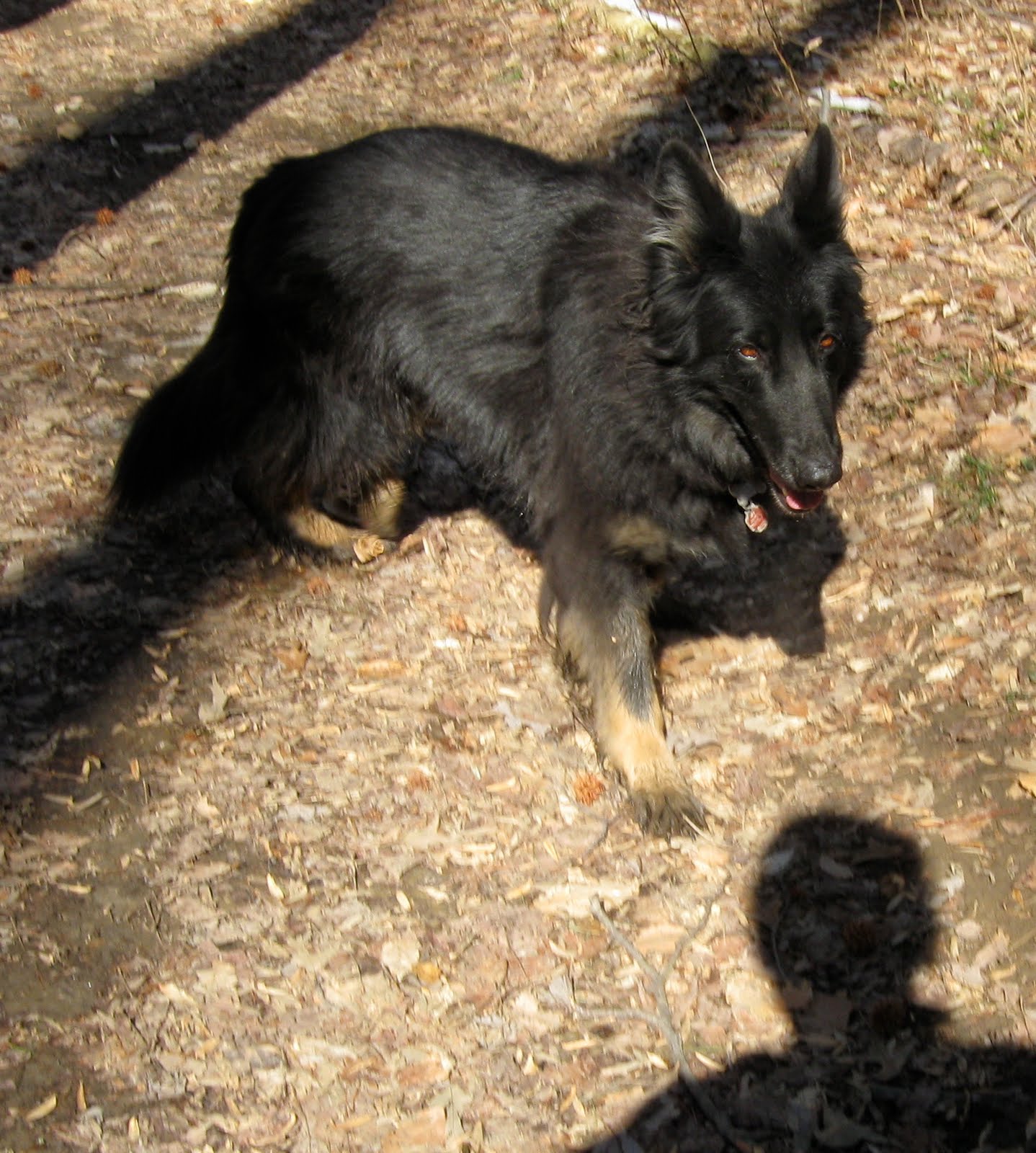
So, in this picture, is Lili a threat, or threatened? [Well, in the event, neither, since the shadow is cast by her trusted Pack Leader.] But if she were confronting a stranger, the correct answer would be “both.” Next time you encounter a dog who’s “going to General Quarters” [or find that the Wolf in Your Head is howling], you might try a little musical reverse-engineering, yourself.

Leave a comment

Filed under aggression happens, limbic system, semiotics

"Softly, softly…"


“…catchee monkey,” goes a proverb so old that its origin is anybody’s guess. Early 20th Century Britons assumed it came from somewhere in Asia [China or India, somewhere with free range monkeys, don’t you know]. It means, “You are more likely to catch a fugitive (thought or creature) by guile, than by charging at it directly, all guns blazing.”

My absolutely fave UK telly show in the early 60s was Z Cars, a cop show, wherein the Baddies were pursued by pairs of what are now called “gavvers” in unmarked Ford Zephyrs [whence the show’s name]. Car chases took a back seat to good character acting, some of it undoubtedly improvised, since the shows were broadcast live. By 1966, our heroes had been promoted to detective status, and appeared in a new show, Softly, Softly. All subsequent cat & mouse, “I’ll trick the truth out of you, Clever Clogs,” police procedural shows owe a debt to these 2 series.

One of these, The Bill, ran from the 80s right up until this year, when its producers decided (gasp!) that the story lines were becoming repetitive and predictable! Give over! That’s part of what we all loved about it. In its first decade there was a dour young Scottish detective who, in every episode, to signify that the villain was now ready to “cough” (confess), intoned, “In your own time…”

Which is the point of this post. “Ticking bomb” scenario or not, centuries of clinical experience and modern neuroscience agree: “You can’t hurry truth. You just have to wait.” Remember how Ronald Reagan excused his filmography of grade-B movies: “The studio had us on a tight schedule. They could have it good, or they could have it Tuesday.” Same thing when it comes to actionable intel. We can, by word or deed, exhort the (putative) Bad Guy to “Spit it out!” and get a quick (possibly false) confession; or we can “go all round Robin Hood’s barn” and catch him up in his own tangled web of lies.

The same choice of strategies applies to our own attempts to recover a fugitive thought. No matter how vital a piece of information may be, if we “rack” our brains for it [as in “Nobody expects the Spanish Inquisition!”], we redirect blood away from the hippocampus [the site of memory & problem-solving] to the amygdala [site of “OMG!”]. In academic settings, this is called “brain freeze,” or “an attack of stupid.” Like coaxing a skittish monkey [or dog] across a rickety footbridge to our side, we are likely to get better results with a “softly, softly” approach. Like the Scottish detective, we might try acting less humiliatingly desperate to get our uncooperative brain to “cough” the crucial but elusive intel, and instead intone, “In your own time…”

Leave a comment

Filed under ethology, limbic system