Category Archives: semiotics

Chiaroscuro


(Quoted from The Concise Oxford Dictionary, 1934 ed.) “[Italian: “light-dark”] noun: Treatment of light & shade in painting; light & shade effects in nature; variation, relief, handling of transitions, use of contrast, in literature, etc. adjective: half-revealed.”

On certain Projective [as opposed to Objective] psychological tests–where there supposedly aren’t any “right or wrong” answers, only “revealing” ones–the subject’s use of chiaroscuro [attention to the shading of an inkblot or an ambiguous drawing] has been interpreted in various ways, over the decades. The earliest developers of such tests [seeming to regard their own free associations to “light & dark” imagery as the norm] came up with: “anxiety about shadowy situations,” “fear of the dark,” and “hypervigilance.” I’m sure Carravaggio and his buddies in the artistic school of tenebrism would be amused to know that they were all Nervous Nellies.

By the time I was in grad school, the received wisdom was that use of chiaroscuro–a tendency to go beyond Black & White perceptions of an ambiguous situation, and instead to take into consideration the nuanced gray areas–reflected a capacity for abstract reasoning and empathy.

Like most things in psychology and real life, it could be both, ya know. Lili is most likely to react with alarm to suspected “intruders into her territory” when the light is tenebrous–at dawn & dusk. Like the lads in the lamppost anecdote, most scientific researchers trope to the light, rather than trolling through the dark alleys of half-revealed clues–even if that’s where the keys to understanding emotions and behavior lie. If we can be brave enough to tolerate the tenebrous subjunctive mood–“Well, I can’t say for sure, but it might be this…”–we can often stumble upon a useful truth.

Something seems to be troubling you. You are snapping at others, and shedding more tears than usual, and what a headache you just got! Oy, veh! Could you maybe be angry at someone or some situation? A little something up your nose? Rather than assume you are coming down with a Clinical Depression or “The Dreadful Lurgy” [aka the ‘flu], why not try a little poking around in the shadows of you mind, to see if you can get some instant relief? The “Always? Not always!” prof I told you about had a simple remedy for sudden-onset headache. “Say the name of the guy whose head you want to bash in!” [“Always a guy? Not always.”] Either the headache will go away right then, or you may be having an intra-cranial event. Are you willing to try it, before setting off for the ER? Maybe you could try it on the way. Just to see.

My favorite source of humor on weekday mornings is The Chris Moyles Show on BBC Radio One. The other day Chris was mildly mocking their light-weight, female sports reporter, who had apparently gotten “high as a kite” on one glass of wine at a Karaoke event they were hosting in a provincial pub. “When Carrie’s drunk, she could pick a fight with her own shadow: ‘Stop following me around, and falling at my feet!'”

Feel free to use it. And the possible headache cure, as well.

Leave a comment

Filed under aggression happens, black and white thinking, gets right up my nose, semiotics

Glienicke Breucke: "Bridge of Spies"


Hands up, if you remember the Cold War…or have read any spy novels by John Le Carre or Len Deighton…or maybe saw the movie Funeral in Berlin, starring Michael Caine. In fact and fiction, the little bridge, spanning the Havel River between Potsdam & Berlin, has been the venue for several spy swaps between the Soviet Union and the US, under cloak of darkness. First, Gary Powers, the downed U-2 pilot [no, not part of the Irish band, you Young Ones], in 1962. [Followed by the fictional “Harry Palmer” in 1966.] Then in 1985 the US got back 23 agents in exchange for 4 Soviet agents [such a deal!]; and finally, a 4 (of ours) for 5 (of theirs) swap in 1986.

If you keep in mind that these exchanges happened at night, between warring factions, the metaphor I’m about to lay on you will work better. As a Young One, myself, in the UK of 1960, I used to fall asleep listening to Radio Luxembourg play the latest English & American hit tunes…only to wake up with a shriek @ midnight, when the station switched over to broadcasting Voice of America “information,” only to be promptly and cacophonously jammed by transmitters in the USSR. What a racket! What a rude awakening! What an apt analogy for Freud’s theory of the interpretation of dreams!

Initially, he thought the purpose of dreams was two-fold. They serve to preserve sleep. C’mon, admit it. Have you never concocted an elaborate dream which “accounts” for the sound of your alarm clock, transforming it into something else entirely, just to allow you a bit more shut-eye? Secondly [pace Walt Disney], Freud opined that “A dream is a wish your heart makes, when you’re fast asleep.” His example of this is the sad story of a man whose child has died, for whom he is now sitting shivah. He falls asleep and dreams that he and his child are walking together through a field, with the warm sun beating down on them…until finally, the smell of burning cloth intrudes on his reverie, and he wakes up, to discover that a candle has fallen over onto the dead child’s bedding and set it on fire. While it lasted, this Restoration dream fulfilled the wish that his child had not died; and, for a time, it “accounted” for the heat & light of the fire [transforming it into a sunny day], thereby postponing the mourning father’s rude awakening.

“Oh, really?” said the skeptics of his time, “Do you mean to tell me that the nightmare I had last night was a wish?” Stand by for a large loophole. The language of dreams is Primary Process (more of an Indie film than a conventional Disney narrative); and the way you express “not” in a dream is to begin a scene and then “yell ‘Cut!'” before its logical conclusion. Always? Not always. Just when the dream makes more sense as a wish, with a “not” thrown in.

Enough quibbling, already. Let’s cut to the chase [scene]. There is an “Iron Curtain” between the Unconscious [where dreams are produced] and the Conscious [where they are shown, shared with friends, underappreaciated…]. Like the Soviets who jammed the Voice of America signal, there is (in most individuals) an intra-psychic “censor,” whose job it is to filter, spin, and otherwise obfuscate the message from the Unconscious. How come? Because the censor thinks “The Conscious can’t handle the truth!” Maybe the truth is inconvenient to the current regime. It might incite the dreamer to challenge the status quo, rock the boat, do something wild & crazy. The more “buttoned-down” an individual, the more powerful his censor is; and fewer of his dreams make it across the Glienicke bridge.

Here’s where the “tradecraft”–the cloak & dagger passing of secrets, as described in the novels of le Carre & Deighton–comes in. The message has a better chance of slipping past the censor if it is encrypted. Freud described two common forms of encryption: displacement & condensation. In dreams, actors rarely appear as themselves [except, like Hitchcock, for brief cameos]. So where do the characters come from? And, for that matter, where do the plotlines come from? Often, from current events, mass media, and the dreamer’s daily routine. Freud called this Day Residue. In his dream decoding algorithm, Day Residue is “subtracted” from the Manifest Content of the dream; and the remaining images (especially the odd ones) are assumed to be displacements or condensations of two (or more) images, which need to be deconstructed, for the dream’s Latent Content to be discovered. Got all that?

Let’s use a dream I had in graduate school, to practice decryption. “I have just come out of the 72nd Street subway station and am waiting to cross to the East, but there is traffic from both Broadway & Amsterdam Avenue. I don’t have time to wait for a ‘walk’ sign, so I intend to jay-walk, when there is a lull in traffic. Here comes a furry limousine, moving very slowly. I could definitely dart across in front of it…but I feel the need to reach out and touch it as it passes by.”

Day residue: That’s my real-life subway stop, my etoile of streets to cross, and my typical late-for-a-very-important-date mindset. What’s left, if we take that away?

Odd image: “Furry limousine, moving very slowly.” My free association: “Looked like a Cadillac. Hate them! Make me carsick. Grandparents always drove them. Why furry? This is Springtime. Who wears fur in the Spring? My maternal grandmother wears those weasels biting each other around her neck, even in mild weather. Why moving slowly? Like a hearse? ‘Reach out, reach out and touch someone’ is the current jingle for Bell long distance telephone.”

Latent content: I wish to call my grandmother, before she dies.

“BFD!” I hear you say. But, for complex tribal and power subtext reasons, I had been estranged from my grandmother for about 5 years. Still, having deconstructed a possible meaning for the dream, I went ahead and enacted the “latent wish,” and called her. [She mistook me for my sister, and mentioned she was feeling her end was nye; but when she realized she was talking to me, she back-peddled and hung up.] And, verily, she died later that week. No, I didn’t cause her death, or even really predict it. [She was in her 80s, after all.] I did allow a coded message from my Unconscious to affect my behavior regarding her; and I am very grateful that I did.

Next time you remember one of your dreams, why not see if you can decode it? You are not obliged to enact every “wish your heart makes”; but dreamwork (like wolf-work) often provides valuable “inside information,” to those brave enough to undertake it.
Leave a comment

Filed under altered states, Freud meant..., power subtext, secret code, semiotics

Consider the Source


In all the stage, telly & film versions of Shakespeare’s play Richard III I’ve seen, he wears a gaudy, gold piece of bling: a heavy chain necklace with a wild boar pendant. Now, why is that? “Cuz that was his heraldic emblem, innit?” How come? “Cuz he was a hunchback, all bent over like a wild boar, innit?” How do we know that? “Cuz that’s how Shakespeare had Richard describe himself, right at the opening of the play, innit?” But Shakespeare wrote the play more than 100 years after Richard’s death. How did he know what Richard really looked like? “Cuz, clever clogs, a Yorkshire school master, name of John Burton, wrote in 1491 (within living memory of Richard) that he was ‘an hypocrite, a crouchback, and buried in a dike like a dog.’ Innit?”

Well, it’s clear that Burton was no fan of the last Plantagenet king (nor was Shakespeare, who was kissing up to his own monarch, Queen Elizabeth I, of the rival gang, the House of Tudor). But his research was a bit dodgy. “Crouchback” was a family name in the House of Plantagenet [not a diss or a diagnosis], referring to the family’s right to wear an embroidered cross on the back of their formal wear, cuz their ancestor, Henry Plantagenet, fought in [and funded] the Crusades. Ya see how these urban legends get started?

Do you believe everything you read [or hear] in the media about Hollywood’s “royalty”? How can you, when every week two adjacent tabloids at the grocery check-out are contradicting each other? Do you believe in the genuineness of paparazzi photos, or have you twigged to the magic of PhotoShop, by now?

If you are female, do you believe that Barbie’s proportions represent the Platonic Form of Absolute Feminine Beauty? If so, you have something in common with the not-so-ancient Chinese, who bound infant girls’ feet, to keep them from growing [also, alas, keeping them from supporting the weight of the unfortunate girl, when the rest of her body grew up, so that she had to be carried around, like…um…Barbie].

See where I’m going with this? Be very careful in your choice of Body Image role models, for yourself or for those in your care. Ask yourself, who gets to decide what size [of foot, or body] is The Right Size? If you know someone who looks like a runway model, regard them with pity, not envy; for such cadaverous thinness [usually] comes at the cost of long-term health. A male cousin of mine [who studied at a famous UK ballet school in the 70s and danced professionally], gave us a glimpse into the grim reality behind those fairy-princess-looking girls. That ethereal look was [most often] achieved through the imposition [before the legal age of consent] of a forced choice: the humiliation of constant criticism for weight gain [soon followed by fear of dismissal from the school or professional dance company], or the pain & suffering of a life-long battle with Eating Disorder.

Last year, after the death of 3 South American models in their quest to compete with their European “colleagues” for angularity, there went out an international hue & cry, to insist that runway models must have a doctor’s certificate of “healthy Body Mass Index” before they could work in the fashion industry. Didn’t happen. Fashion designers refused to provide attire sized to fit the “certified healthy” models. Think about the priorities of such people, and those in the media who allow them to dictate what will be The Look for this Fall. Before you buy into their hype, that their Look is the Only Acceptable Look for this season [“Wear It or Be Square”], consider the source.

Leave a comment

Filed under attribution theory, body image, semiotics, sharks and jets

Lili the Rorschach


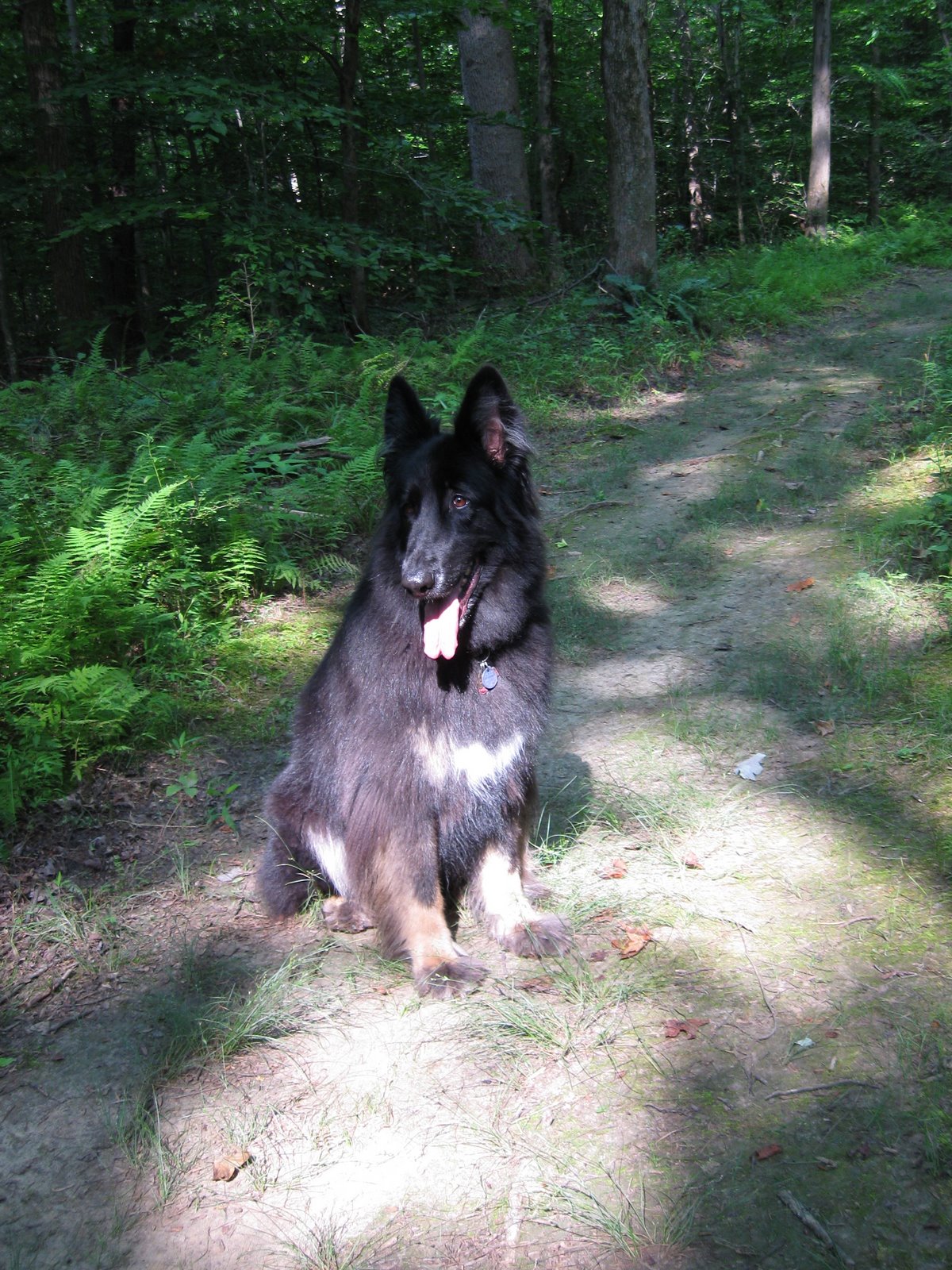
This morning’s walk through the woods was a harbinger of Fall: cool, blustery, intermittently overcast, with a forecast of rain. I put on a waterproof, fawn-colored riding jacket, and off we set. At the midway point of the trail through the woods, I heard my least favorite sound: gunshots, very close. I happen to know that deer hunting season is weeks off, so neither Lili nor I were wearing our day-glow safety vests. In fact, obscured by the leafy trees, we might have been mistaken for a wolf and a deer. Spurred on by fear, not to mention the intrusion of [let’s just hope] hunters jumping the gun, we picked up the pace and headed for the relative safety [because of our higher visibility] of the playing fields. But just as we approached the turn off, we heard police sirens near the school, and decided to stay on the lower-viz, wooded path. By the time we reached the paved road that leads back to where the car was parked, both the gunshots and the sirens had stopped, so we relaxed the pace to a brisk, dog-show trot.

When we reached the car, it was blocked by two county utility vans. “Oh, swell!” I thought. “Having dodged bullets in the woods, now we’re going to get hassled on the open road.” The driver of one truck rolled down his window and asked, “Where’d you get that dog?” “In Virginia,” I said with a smile [projecting my best not-your-victim-not-your-enemy subtext]. “I’ve never seen anything like it! What’s ‘he’ weigh?” Going into my Lili-is-not-your-enemy mode, I said, “She’s a girl, and she only weighs 71 pounds, under all that fur. Soaking wet, she looks like a greyhound.”

To which he replied, “It looks like a bat! Never seen anything like it! Have a nice day!”

And the point of this little vignette? Scary is in the eyes [and ears] of the beholder [listener]. Unless I hear on the news about a gun battle in my local woods [which is not unprecedented], my amygdalar arousal was as much of a false alarm as was the initial reaction of our new friend, “Bat man.”

But I think we’ll start wearing those safety vests again, in any case.

Leave a comment

Filed under attribution theory, limbic system, semiotics

"Over a Barrel"


Riding my usual hobby horse today: the double [sometimes, opposite] meanings of certain figures of speech. When you hear the title phrase, do you think “at someone’s mercy,” or “having been rescued from near-drowning, being draped over a barrel to clear the lungs of sea water”? According to all my UK etymological sources, the latter is the first meaning; and it supposedly originated in the States in the 1800s. Only later, in the early 1900s, did it come to mean “being hazed, as in a college fraternity ritual.” Also, supposedly, an exclusively American practice.

Oh, yeah? Well, I’ve just been browsing the British House of Commons debates from 1846 and 1906, concerning punishment by flogging in the Royal Navy. [Actually, I knew about this before, but it’s a trip to read the debates verbatim.] In the former debate, a bill was put forth stipulating that flogging could be legally administered only after a Court Martial [not just at the whim of any officer on board]; and the 1906 bill advocated the abolition of flogging, altogether. Incidentally, the euphemism for a sailor’s being tied to the barrel of a ship’s cannon, in the proper position to receive up to 48 lashes with a cat-o’-nine-tails, was “kissing the gunner’s daughter.” And when someone says of a tight space, that “there’s hardly room to swing a cat,” they are referring to this man-made flayer of human flesh [not a pussycat]. On some ships, though, a milder version of flogging for sailors under the age of 16 substituted a whip of 5 [not 9] strands, without the 3 knots per strand, which was called a “boy’s cat” or “pussy.”

And now, to the [metaphorically] related topics of a modern form of child discipline in America [the Time Out], on the one hand, and invasive medical procedures, on the other. Consider first the aphorism, “A kitchen contractor is a vandal that you pay; and a surgeon is an assailant that you pay.” Partly because of the truth of the first statement, more and more of us opt to Do-the-Home-Improvement-Ourselves; but very few of us opt to perform surgery on ourselves [not even physicians]. So we pay [or at least co-pay] to be assaulted [you know, like, cut open], in the hope that some good will come of it. No matter how much reasoning with yourself you do, about why a given procedure is necessary, there’s no escaping the Big Four irritants: the intrusion, the humiliation, the fear, and the pain & suffering. And what if the procedure doesn’t even purport to be curative, but only diagnostic? [Let your wolf mull that over a bit.]

So, back to Time Out. When a parent says to her/his obstreperous child, “Do you want a Time Out?” I always wonder if they really mean, “Do you want a [mild form of] punishment?” or “Do you want to take a moment to try to compose yourself [with a variant of Zen meditation]?” Is it a threat or a Serving Suggestion? Is it rhetorical [like “Do you want to make a scene?”], or is it Conative? Remember, way back in the beginning of this blog, Jakobsen’s 6 Speech Functions; and one of them was to Give an Order [Even to Oneself]? So, either “Do you want a Time Out?” is a roundabout way of saying “Do you want to pipe down?” or “Why don’t you pipe down?” or even “Pipe down, already!” Trouble with being Conative, though, is that it’s so in-your-face-and-on-your-case. It’s so I-am-the-boss-of-you: so…Packer Leader. [Mull it over.]

When, as a Lieutenant Commander, I used to stand the ER watch at Newport Naval Hospital, back in the day, with my [future] husband, I got to listen to him try to avoid giving direct orders to his patients [even though, as a Naval Officer, he outranked most (not all) of them, especially the drunk & disorderly sailors who made up the lion’s share of our nighttime clientele]. “Why don’t you get up on the exam table?” said he [rhetorically, I assume]. “Cuz I don’ wanna!” replied one under-age-but-way-over-the-limit young man. “Sailor, get yourself up on that table!” the future father of my future children commanded. And thus did an Able Bodied Seaman [a rank, not a diagnosis] begin his ordeal of intrusive, humiliating and painful [but life-saving] treatment for acute alcohol poisoning, for which, given the venue, he was not even charged a co-payment.

You might say that the Navy [and, especially, the ER treatment team] had him over a barrel.

Leave a comment

Filed under gets right up my nose, power subtext, semiotics

Attractive Nuisance Doctrine


First let me make a cheap pun at Zanzibar’s expense, and say that because he is usually purring at my elbow when I’m writing this blog, it is his fault that I don’t catch all the typos before hitting “publish.” Like typing “Packer Leader,” when I meant, of course, “Pack Leader,” in the previous post. “If only his eyes weren’t so adorably blue…”

As those of you who have a swimming pool on your property know [and we learned, when we bought Dusk the QuarterHorse], an “Attractive Nuisance” is a term of art in tort law, referring to any animate or inanimate object which poses a threat, “because of its attraction, to children who will be unlikely to recognize its dangerous quality.” [Webster’s 1988 ed.] In Michigan [where tort lawyers abound] we had to buy Attractive Nuisance liability insurance on Dusk, even though she lived at a private riding stable, across town from our home. [In fact, she lived in Sterling Heights, whence cometh Marshall Mathers III. Check it.]

Now let us consider the External/Internal Locus of Control doctrine, which the UK researchers tried to measure in 10-year-olds, with a self-report questionnaire. A girl with a high level of External Locus of Control will tell her parents, “The horse whinnied at me, so I knew it was hungry, so I gave it my Ice Lolly to lick [remember, we’re in the UK], and it bit my hand!” [In Michigan, that would be a Popcicle.] Was a sign posted on the stall door, saying “Do not feed this horse without owner’s permission”? Not good enough. What if the child is too young to read? Tell you what the management at the London Zoo do. They post this surreal but high concept sign with a human hand, out of which a cookie-cutter-[or, biscuit-cutter]-shaped chunk is missing, near the cages of animals whom it is dangerous to feed. Next time I own a horse, I’m posting that sign on the stall door.

What if the horse spared the child, but ate the rod [in this case, the Ice Lolly/Popcicle stick]? Would the family of the young doner of the ill-advised confection be liable for the vet bill, to remove the wood splinters from the horse’s throat? Not bloody likely! The horse would be diagnosed with “Dietary Indiscretion,” and its owner would be charged for its treatment.

So, you see where I’m going with this, right? Up to a certain age, the law attributes External Locus of Control to young ones, and blames bad outcome on others [man & beast]. After that age, though, all bets are off. If, as a teenager, you schmize my horse into eating a dangerous stick [and I catch you at it], you’re guilty of animal abuse. An adult caught feeding a zoo animal will be prosecuted [right after being discharged from the ER]. So, how is this shift from External to Internal Locus of Control supposed to happen? Passage of time? Trial and error? Fairy dust?

I happen to believe it happens by grown-up Pack Leaders [there!] keeping an eye on young ones, and issuing Conative commands to them [such as “Don’t feed the animals, unless you ask first.”], along with a Sound-Bite-on-Why-Not. [“Cuz I say so,” does not count as a Sound-Bite-on-Why-Not, incidentally.] So, here’s what I’m saying, grown-ups. Man up, and risk the humiliation of a hissy fit from the thwarted young person [or their doting parents], in the name of animal welfare, of child welfare, of public order. Think of these Sound-Bites-of-Why-Not as your own, award winning Public Service Announcements. The more novel and amusing [usually], the more effective they are.

The alternative is the intrusive mission creep of increasingly silly tort avoidance notices from which we now suffer, warning us that a cup of Hot Chocolate “might be hot.” That raw eggs may contain salmonella. That roads may be slippery when wet.

Get working on those PSAs, folks.

Leave a comment

Filed under leading a pack, locus of control, pro bono publico, semiotics

"A nod is as good as a wink to a blind horse."


This old Cockney expression, first cited in 1794, means, “Do I have to spell out the obvious to you? You know what I mean.” [Lately, contracted to the Phatic, “Nar’mean?”] Well, here is my corollary: “A diss is as bad as a threat to a young man.”

Waratu Sato [& colleagues] of Kyoto University have made headlines this week with their research on 24 incarcerated juvenile delinquents, compared to 24 “control” subjects, whose average Verbal IQs were 28.4 points higher than their jailed brethren. [The Controls’ mean Verbal IQs were in the High Average range, whereas the JDs’ were in the Low Average range.] As the discussion portion of this breathlessly-hyped-in-the-media article points out, the IQ factor might account for all the difference between the two groups’ performance on the task. Meanwhile, let us consider the task, itself. Each subject was shown a series of photographs of faces “portraying” one of 6 emotions, which they had to identify correctly. [Wait. Remember the dog-bark-translator, also from Japan, which categorized canine utterances into one of 6 emotions? Hmm…] Anyway, the headline was that the 24 JDs kept “misrecognizing” facial expressions of disgust for anger. So, incidentally, did the Control subjects, but 17.2% less often [which the researchers, themselves, acknowledge is “not a large difference”]. And their conclusion? “One of the underpinnings of delinquency might be impaired recognition of emotional facial expressions, with a specific bias toward interpreting disgusted expressions as hostile angry expressions.” On the other hand, as has been empirically demonstrated for centuries, one of the underpinnings of delinquency might be lower verbal IQ. Nar’mean?

But this is not Sato & Co.’s first foray into studies involving distressingly Photo-Shopped facial expressions. As reported in NeuroImage in 2004, 5 females and 5 males [mean age 24.4 years] volunteered for a [non-diagnostic] fMRI study, comparing their amygdalar responses to facial expressions described as angry or neutral, sometimes facing head-on, and sometimes slightly averted. Guess what they found. Head-on angry faces aroused an amygdalar response [in both men & women], whereas averted angry faces did not. Nor did neutral faces, no matter which way they were pointed. And these subjects weren’t even delinquents!

Apparently, even in Japan, researchers enjoy circling the lamppost, in order to discover that which is already known. Are you tellin’ me, the culture which introduced the Western World to the notion of seppuku [aka, hara-kiri] as a rational response to “loss of face” [aka, receiving a look of disgust, or a diss] doesn’t see the nexus between disgust and anger? Well, I do, and I’m Irish. Anyone who has ever read urban anthropology [or the newspapers] is aware that most youthful violence is triggered by one party giving the other party such a look [of disrespect], that honor demands a hostile response [usually towards the dissing party, but sometimes, turned inwards towards the dissed, himself, out of unbearable humiliation]. Nar’mean?

Street savvy youth [and their elders] learn to avoid inadvertently giving such facially expressed offense by taking a leaf out of the Viennese [Dissed] Clever Dog’s book, and averting their gaze. Further, those of us using public transport in the wee hours, learn to “keep our eyes in the boat” and/or to monitor our facial subtext for inadvertent expressions of disgust, and to verbally override them, with such remarks as, “Yuck! I think I may have food poisoning! Oh, well. Worse things happen at sea, right?” The only threat such a remark poses to fellow travelers, is to their clothing, not to their self-worth. No diss, no hostilities. [Usually, not always.]

I was waiting on line at the clinic pharmacy today, where the TV had some inane talk show on, with a guest who may have been the younger brother of a Backstreet Boy; and the interviewer said to him, “What other people think of you is none of your business.” Well, the studio audience applauded. [And so would I have, except that I was at the clinic pharmacy.] What a wonderfully powerful antidote to the infuriating toxin of humiliation! If someone gives you a look of disgust, it’s none of your business. Avert your gaze and tell the wolf in your brain to pipe down, already. Nar’mean?

Leave a comment

Filed under confounds, murky research, power subtext, semiotics

Turn On the Waterworks


What’s the good of crying? [That’s not a rhetorical question.] Sir Henry Maudsley (1859-1944), a neurologist and psychiatrist who took care of shell-shocked Australian soldiers during World War I, knew the answer: “Sorrows which find no vent in tears may soon make other organs weep.”

Ancient Greek dramatists knew it, too, staging tragedies so shockingly blood-thirsty [remind you of a current genre?], that audiences were guaranteed to have a good, cathartic cry. Today on the Beeb [BBC radio 1, that is], as Trueblood makes its UK debut, a group of media mavens were asking each other, “What is this current fascination with vampires and such?” One pundit opined that “in times of economic distress, people need an outlet for their own misery and fear, so they give themselves a socially acceptable reason to weep and wail.”

Cue the Possibly-Mad-Scientists. My personal fave is Jaak (not-a-typo) Panksepp [originally from Estonia], who coined the term “affective [pertaining to the emotions] neuroscience.” He studies the vocalizations of animals, such as rats, and has found that they wail with distress and laugh with delight. [Today’s post is no laughing matter. Later for that.] So, guess what familiar substance is found, in significantly elevated levels, in the saliva of wailing rats (inasmuch as they do not shed tears of sorrow)? CORTISOL. It’s also found in the tears and saliva of crying humans, folks. Talk about catharsis!

So, when Lili makes that keening noise as she is sent [or, these days, sends herself] to the basement, for the misdemeanor of barking at the UPS guy, an analysis of her saliva would likely show a whole lot o’ cortisol, which she cleverly lets “Duck” [her comfort stuffed animal] absorb, as she holds him in her mouth. In a few moments, she regains her composure and is back upstairs, happy as Larry [an Australian idiom, meaning “very happy”]. Very few of Maudsley’s wartime patients were Happy as Larry, one gathers.

How lucky for Lili (and Jaak’s rats, and human children), that society permits them this low-tech method of ridding the body of toxic cortisol. How unfortunate, that when grown-ups (especially men, or women in non-traditional jobs, such as the military) weep, they are humiliated with labels such as “weak,” “manipulative,” or “suffering from a Mood Disorder.” Recent research purporting to demonstrate that weeping only makes men more distressed [especially studies using my least favorite research tool, the fMRI], have been critiqued as culturally-biased. The subject’s (radio-active) brain is registering the anticipated, negative social consequences of crying, not a “hard-wired” neuro-chemical consequence. The brain of a male actor anticipating an Oscar nomination for his convincing on-screen crying [I hypothesize] would look very different in such a study, from his brother, the Marine Corps Drill Sergeant.

Which reminds me of a harrowing but invaluable class in our acting school, in which male & female students alike had to produce real tears on cue, for a grade. In keeping with the school’s Method Acting approach, no artificial means of lacrimation [such as onion juice on one’s fingertips, or a tack in one’s shoe] were permitted. The actor must Prepare: conjure up a powerful, tear-jerking memory, and use it as the spigot, to Turn On the Waterworks. Just imagine the endorphin hit which follows the [male or female] acting student’s right-on-cue crying jag. Talk about tears of joy!

Which we will, in the next post.

Leave a comment

Filed under catharsis, murky research, semiotics, stress and cortisol

What are you laughing at?


Tell you what Arthur Koestler thought. In 1964 he wrote a tome on the subject, The Act of Creation, the burden of whose 751 pages, is that all humor, scientific discoveries, and works of art occur when two worlds collide. He put it rather more ponderously, “when two matrices bisociate.” By this he meant, when two frames of reference [each with its own rules of logic] are unexpectedly juxtaposed. Abstract and boring enough for ya, so far?

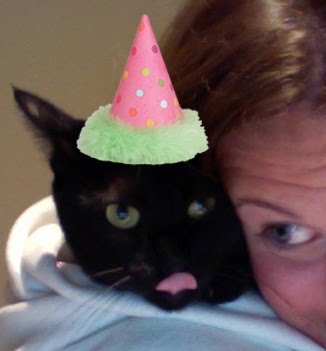
Consider this visual joke: Penny the Cucamonga cat is “wearing” a [photo-shopped] party hat, looking anything-but-in-a-party-mood, being held by my daughter [most of whose festive facial expression I have discreetly cropped away, to preserve her privacy]. Koestler would say that there are at least two matrices bisociating here. Penny, a cat, is impersonating a human “party animal,” which is also a pun; and the obvious photo-shopping of the party hat is my daughter’s mockery of the shoddy paparazzi “photo-journalism” ubiquitous in LA, where this picture was taken. Not unlike those ancient philosophers, Koestler believed that in all humor there is an element of defensive-aggression, against the butt of the joke. In this case, the joke is metaphorically on Penny [since we know how much pets detest wearing silly human costumes for gag photos]; but it’s actually on the paparazzi. Geddit?

Let’s go back to my fave joke, introduced in the “Funny Bone” post. “Horse walks into a bar. Bartender says, ‘Why the long face?'” One matrix is the well-worn, formulaic [mostly New York-based] genre of “guy-walks-into-a-bar-bartender-says-why-the-long-face?” joke. This collides with a more obscure joke tradition [mostly in Ireland & the UK], of placing horses in unusual settings. Back in the day, there was a series of print ads for whiskey, using the slogan, “You can take a White Horse anywhere.” Near the beginning of the cult Irish flick, Into the West, a [white] horse is taken by lift up to the top floor of a council housing flat in Dublin, and the human passengers on the lift don’t bat an eye. [A nod to the whiskey slogan.] That gets the horse into the bar, in my fave joke. The second matrix is a pun: a play on the words, “long face.”

But where’s the element of defensive-aggression in this oh-so-sophisticated joke? The butt of the joke is the genre of joke, itself. It is what Jon Stewart would call a meta-joke. It is a joke about a type of joke. Probably, it resonates most with those of us who have tried to “be funny,” for a living [or for a grade in acting school].

Those of you who remember Jakobsen’s six Speech Functions will be raising your hands and “chirping” [@ 50 KHz], “Oooh! Oooh! This is Poetic Speech we’re talking about! Designed to Tell the Ugly Truth without Suffering the Ugly Consequences.” That is exactly what we are talking about. The teller of the joke [little David] gets to poke fun at big, bad Goliath; and the laughers at the joke get to expend their adrenaline in a non-combative manner. If they laugh until they cry, they even get to purge themselves of some cortisol. Goliath is mocked, but everybody survives. That’s what Koestler thought; and his most enduring book is Darkness at Noon, a repudiation of the “Goliath” of Communism, with whom he had previously cast his lot in the 1930s.

Now, back to Jaak’s laughing rats and tickling. [I’ll leave the cocaine commentary to the Wallabies among you.] Koestler believed that what rats [and little children] find laughable about tickling is that it is a mock attack. It’s funny because they know they are not really in danger of pain & suffering. The tickler is only impersonating an attacker. If actual pain results, or even the fear of pain, it’s no laughing matter. In fact, Jaak found, if even one cat hair [a signifier of threat from a predator] is in the room where a rat is being tickled, the rat will not “chirp” [@ 50 KHz]; it will bum [@ 22 KHz].

The rough-and-tumble play of all baby mammals produces “chirps” of glee. In developmental psychology, this epitomizes the concept, “This is only pretend.” Sigmund’s daughter, Anna Freud [she of the German Shepherd “Wolf”], called this Regression in the Service of the Ego one of the most important defenses older humans can use, as a respite from the real [not mock] threats in their lives. When we laugh at Jon Stewart poking fun at Kim Jong Il, we are pretending that the threat that little martinet poses to the world is “only pretend.” For that little moment, we are regressing to a childlike belief that Kim is just a joke [and giving our overtaxed limbic system a rest].

So, go ahead and laugh it up, folks. Feels great, doesn’t it?

Leave a comment

Filed under comic relief, limbic system, pragmatics, semiotics

Lumbered


In 1961 our family [and just about everyone else in the UK] went to see Anthony Newley’s WestEnd musical, Stop the World, I Want to Get Off, which was thrillingly cynical [especially to us Young Ones], about what is euphemized in the US as “a shotgun wedding.” Newley wrote & sang the phrase, “I’ve been lumbered.” It sounded like another example of Cockney slang [the meaning evident from the context]; but it’s actually ever so old, dating from the 1500s in England, and the 1300s in Continental Europe. It refers to an Italian ethnic group, the Lombardi, who were pawn-brokers and money-lenders. Lombard Street in London was so named for its plethora of pawnshops. [Incidentally, did you know, “Pop goes the weasel” is a euphemism for pawning a fur garment?] The Oxford Concise Dictionary (1911 ed.) defines “to be lumbered” as “to be burdened with something unpleasant” [which pawn-brokers were: namely, the “popped” weasels, used furniture, and other old tat that their clients had exchanged, for enough money to buy more rice & treacle]. Nar’mean?

Last week’s exploration of Guthrie’s One-Trial Learning theory was prompted by an event in the forest, during Lili’s & my morning walk. It had been raining for days, and then it got windy. The beaten path was like a waterslide in the downhill parts, to avoid which, I was detouring right through the trees, for better footing. As I came to the next downhill bit, I heard a tremendous crack, like the detonation of a shotgun, directly in front of me. First, I froze. Then I looked behind me, to see if a deer had been shot [since I, happily, had not]. Then I looked directly ahead, to see if I could spot a hunter and tell him to cease fire. Lili, meanwhile, looked straight up. Following her gaze, I saw a huge branch break off a tree, and fall right on the spot where I had planned to walk. Amazingly, I did not utter my trademark Hitchcock-victim scream, but just calmly followed Lili [my Pack Leader pro tem] along the slippery path, away from the newly fallen lumber.

We used to think Lili was silly, to look up warily at every looming object she passed [such as playing field lampposts, the water tower, and even our ceiling fan, when it first turns on or off]. Now I get her point. I was looking everywhere but up, in the woods; and without Lili’s vigilance I would have been well and truly lumbered.

Then I wondered if the next day I would shy away from that specific part of the woods, or if I would be more amygdally aroused in general, especially by any “gunshot” noises. In fact, I was able to cognitively reframe the falling branch as “a lucky escape,” rather than a “trauma”; and we have had remarkably serene walks. Today was the first time my husband has been able to come with us in two weeks, and it had been bucketing rain last night, so I remarked, “I hope all the branches have done their falling, by the time we pass through.” Several 100 yards past the site of last week’s fallen branch, he pointed to an 8-inch-in-diameter, newly fallen tree, lying directly across our path, and said, “Well, there you go.” [It’s not the one pictured here. No camera today.] Lili glanced up warily at an adjacent, precariously-balanced tree, decided it posed no immediate hazard, and jumped over the fallen lumber.

So, even without a tailor-made X-Box game [Timber!], I have been able to do my own limbic debriefing, and avoid being lumbered with a fear habit about our beloved walks on the wild side. In the thick of the forest, I will trust Lili’s big ears and big eyes, to warn me of impending danger from above. Still, I will be the judge of whether the people and animals we encounter on the ground are friends or foes.

Meanwhile, since last week, I have not flinched once while riding shotgun with my husband. See, we can learn to tame our Wild Things [aka howling limbic wolves], of which, more next time.

Leave a comment

Filed under limbic system, post-traumatic stress, semiotics