Category Archives: semiotics

"How do children survive?"


Maurice Sendak’s question is quoted at the top of an article about Where the Wild Things Are, in The Psychologist, the journal of The British Psychological Society [of which I have been a member since the 70s], written by an American psychoanalyst, Richard Gottlieb, whose thesis seems to be that Sendak had a rotten childhood, so he writes about children having rotten childhoods, who nevertheless, against all odds, survive.

Predictably, I beg to differ. Some aspects of Sendak’s childhood [like yours & mine] were rotten. His genius has been to transform his tough stuff into images [visual and verbal] that kids receive with delighted recognition: “I know just how Max/Mickey/Pierre/Really Rosie feels, cuz sometimes I feel that way, too.” In Gottlieb’s tone, I detect the whiff of unacknowledged wolf. He even tries to make psychoanalytic hay out of Max’s wearing “his wolf-suit” [which, tonight being Halloween, I’m betting we’ll see more than one of, at our front door]. To paraphrase Freud, sometimes a wolf-suit is just a wolf-suit.

Now, to introduce Ying Tong, the Worst Cat in the World, whom I credit with my childhood survival. Like little Maurice, I was a sickly child [although my parents didn’t “make a dog’s dinner” of their concerns about my health, unlike the Sendaks]. In the winter of 1961 I developed severe bronchitis, and my constant bouts of phlegmy coughing made it almost impossible to keep food down. When we had moved to the UK the previous summer, we had tearfully left our dog Alfred behind [because of the draconian 6-month quarantine rule], so on Christmas eve my father burst into the house [bleeding and swearing profusely], and pried a black & white, snarling Wild Thing off his neck, saying, “Merry effing Christmas!” My parents had secretly agreed that the family needed a local pet, to ease the loss of Alfred. The cat was a rescue from the RSPCA, supposedly female [and therefore named by my mother “Jingle Belle”]; but later assessed by the vet as Ever So Male: “Perhaps you would like to call him ‘Jingle Bill’?” We fell into the habit of calling him Ying Tong, after the Goon Show song, “Ying Tong Iddle I Po.” [Another gem of non-lexical vocables, suitable for lowering anxiety.]

The cat was the bane of the street, commando-raiding the neighbor children’s outdoor tea table and making off with their Marmite sandwiches; climbing another neighbor’s sapling tree and chewing off all the buds. Inside the house, he would lurk under my bed, snarling with menace. I would do the longjump from the hallway to under my bed covers, and he would pounce, trying to bite me through my many layers of duvet. Then [and this is the Beauty Part] he would curl up on my chest and fall asleep. My parents theorized [and I agreed] that the very credible threat of a woken up Ying Tong’s wrath would strongly motivate me to resist the urge to cough, thereby keeping my food down and my strength up. And, lo, I survived! And, despite his rotten disposition, I just loved that cat.

The week we were set to move back to the US, a worried neighbor knocked at our door, asking if we owned “that large back & white smooth.” My mother said, “Yes. What’s he done now?” “Well, I’m afraid, been run down by a lorry. He’s in our front garden,” said she. Cheer up. He didn’t die from his injuries, which were extensive: a broken hind leg, a broken jaw, and a gash in his side. In fact, he became [marginally] sweeter. Because he chewed off his plaster cast on the voyage home, his leg fused in a straight-out position; but that did not affect his agility or speed. When we got to our new duty station, we were [unexpectedly, but joyously] reunited with our beloved dog Alfred, and were also given a gray & white cat [whose markings were identical to Ying Tong’s]. That cat had 7 kittens [none of which was going to St. Ives], all of whom learned to sit with one hind leg extended, in apparent emulation of “Uncle Ying Tong,” who lived to the age of 18.

So, my answer to Maurice Sendak’s question is: Children survive by consorting with fierce creatures [both human and 4-legged; both inside themselves and Out There]. To make the wolf [or a vicious cat] your friend is sometimes the key to making it into adulthood, against all odds.

Leave a comment

Filed under Freud meant..., object relations theory, semiotics, transitional objects

Gingerism Is No Joke


Centuries before those wiseguys, Trey Parker & Matt Stone, wrote Episode 911 of South Park [“Ginger Kids,” which was first aired on 9 Nov 05], individuals with red hair were the objects of fear & loathing, as well as assault & murder. The ancient Egyptians used to sacrifice them regularly, “for good luck.” In Medieval Europe, red-haired individuals were feared as vampires. In Czarist Russia they were all regarded as insane. Frank McCourt wrote that in the Limerick of his youth, redheads were assumed to be of Protestant [Scottish] descent, and therefore hated. In the UK in 2003 [2 years prior to South Park 911, mind you] a 20-year-old youth was fatally stabbed in the back “for being a Ginger,” according to his assailant.

When Rosie received solo-tour orders to Shanghai, 3 months into Myrna’s pregnancy with my older sister, they made a red-haired-girl contingency plan, to “give her a name with its own nickname reference to her hair color,” to spare her Rosie’s fate. In the Chicago of his youth, red-haired children were jeered, “Redhead, gingerbread, 2 cents a loaf.” Thus, in the fullness of time, his shipmate [“Blood” Doner, speaking of onerous monickers] handed Rosie a telegram: “Baby Virginia Darling.” Rosie wired back, “So it’s a red-haired girl; but why the Southern middle name?” [His idea of a little joke.] As often happens with babies, Ginger’s flaming red hair fell out, grew back in blonde, and then morphed into a subtle bronze, like an old penny, not a new one. [For rufus boys, the head-’em-off-at-the-pass name was Russell, so they could be called Rusty, ya know. These days, apparently, it’s Rufus.]

So, what is up with all this ancient & modern “gingerism” [as the Manchester Guardian dubbed this form of discrimination, in 2003], anyway? I shall now [color]blind you with [some genetic and social] science. The rarest of hair colors, red is the result of a [recessive] mutation in the MC1R gene. Because it is highly correlated with pale/freckled skin, it offers the survival advantage of higher absorption of Vitamin D [a protection against Rickets] It is expressed in 13% of the Scots and 10% of the Irish. [Not all of dem, d’ya see, now.] It is “very common” in Ashkenazi [European] Jews. [Think Woody Allen.] Currently in the US, [natural] red hair is found in “2 to 6% of the population.”

Professor Cary Cooper, a British psychologist, opines that redheads are a convenient target of malice, because they are “a visible minority, not protected by law.” Without presuming to know their motives, I speculate that Messrs. Parker & Stone chose “Ginger Kids” for their parable about baseless prejudice, because they had no idea [at the time] that “gingerism” was a real problem. They might just as well have chosen sinistrality [left-handedness, with which red hair is significantly correlated]. Nevertheless, their lack of response, so far, in the face of recent Facebook-mediated, South Park inspired “Kick-a-Ginger-Day” assaults among middle-schoolers, is not very Menschlich [stand-up], in my opinion. Their disclaimer, that no one under 17 [unable to discern Poetic Speech reliably] should have watched the episode, misses the point.

Let’s do a little wolf-work. [Way] back in the day, aggression against the rufus was prompted by fear: of vampires and lunatics. In Limerick [if McCourt’s red-hair-means-you’re-a-Prod association is right], the anger stemmed from the intrusion and humiliation that Irish Catholics felt/feel at the hands of their Scots-Irish [British] overlords. The common association of red hair with a short temper may prompt others to dread that a red-haired person is more likely to inflict pain & suffering [although the scientific evidence suggests that they are, themselves, more sensitive to (thermal) pain than others].

What I wanna know is, what about redheads got up the noses of Parker & Stone, and their media outlet, Comedy Central? Their current silence has the whiff of Unacknowledged Wolf.

Leave a comment

Filed under attribution theory, gets right up my nose, semiotics, sharks and jets

"Stuck in a Moment"


This meditation on the U2 song, which David [“Bono Vox”] Hewson has called an after-the-fact, imagined suicide intervention for his late friend, INXS frontman Michael Hutchence, is dedicated to everyone who has developed a de novo case of Seasonal Affective Disorder this winter. [More snow forecast for this evening in the DC area, tra-la.] It is also about the Gestalt psychologist Karl Duncker’s concept of functional fixity, which Corsini defines [in The Dictionary of Psychology, 2002 ed.] as “the opposite of…creative thinking.”

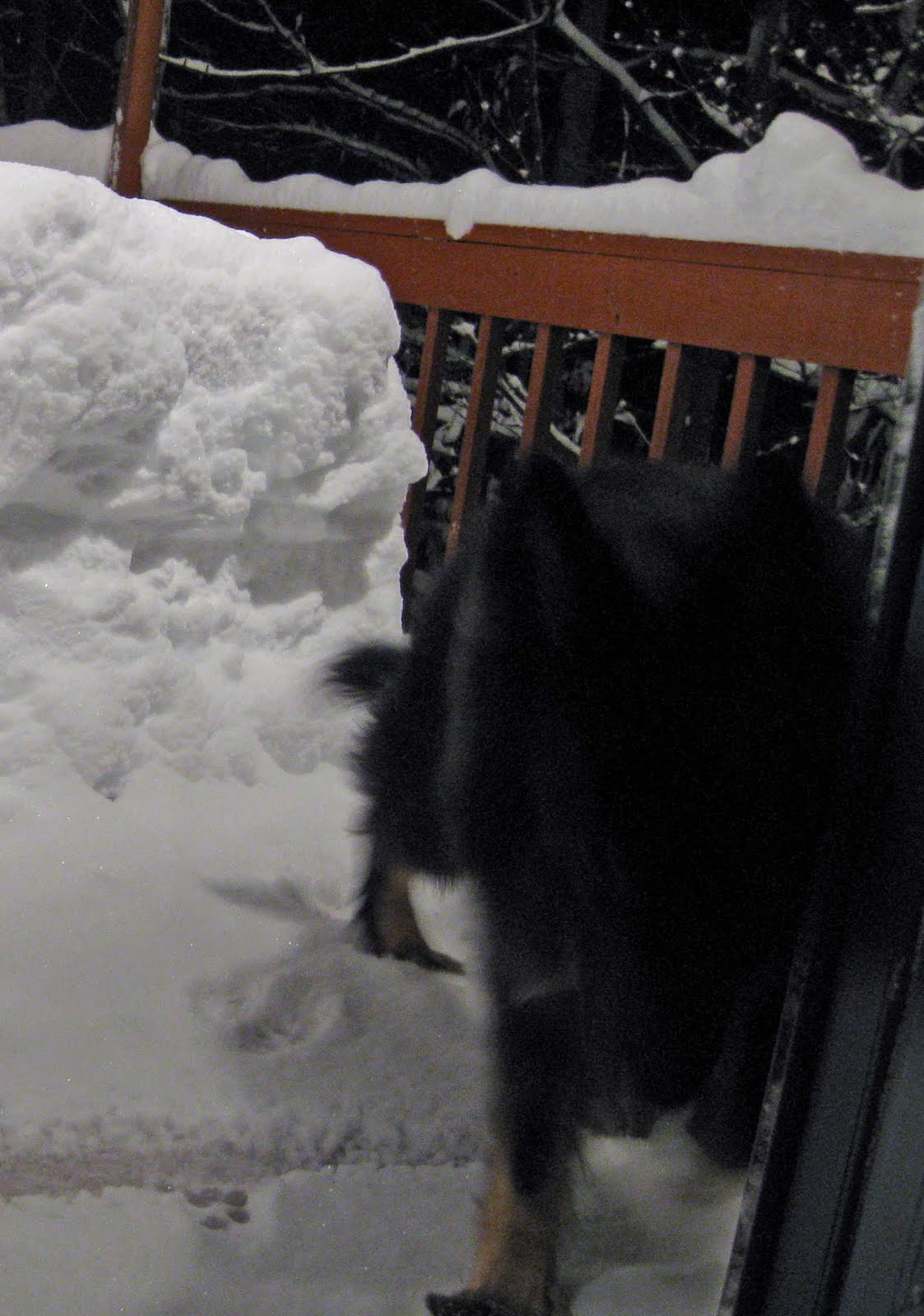
Consider the not-awful-just-highly-inconvenient intrusion of this prolonged spate of foul weather on Lili’s customary, daily ramble-in-the-woods. Until this weekend, the snow in the forest has been up to 3 feet deep, swallowing up the feet [and legs] of all but the snow-show-clad. The first time this happened to me, I was alone with Lili, who was off-leash but skittered over on the frozen surface, merely to bark her encouragement [impatience?] at me; and I began to fear that I would be Stuck in the Moment until the Spring thaw.

Resisting a $100 investment in snowshoes, I began searching for alternative venues for Lili to run, which were both [relatively] safe & legal. When school was canceled, the plowed parking lots were viable, except for some tricky, hard-to-see patches of ice. A couple of days we slogged through 2 feet of slush on the paved path in a local recreational park. [By the way, why all the empty parked cars in the lot? Surveillance or shenanigans?] One day we bored ourselves silly, running up & down our own cul-de-sac street, incensing all the neighbors’ penned-up dogs.

A few brilliant, but not-really-legal venues occurred to me, such as the covered parking lots @ work, the Mall, or Whole Foods. I reconnoitered them with Lili in the car; but the hostile semiotics of the security guards were discouraging. One evening at the almost deserted medical center parking structure, the golf-cart dude pulled up and asked me, “Is there a bomb scare, or something?” [Lili’s semiotics aren’t all that benign, either.] To avoid further humiliation, if not actual arrest, I loaded her up and drove slowly away.

So, there you have it, from one who prides herself on her non-linear, out-of-the-box problem-solving skills. Apparently, my amygdala has been so freaked out by the logistical challenges of this unprecedented spate of snowy weather, that it has hog-tied my hippocampus. [Note the paucity of posts in February.] Finally, this weekend, with a partial thaw and Chris at my side, we ventured into our beloved woods again. It wasn’t easy or pretty, but it was a necessary journey. It restored limbic balance, as well as hope, that “this time will pass.”

And even if Bono didn’t get to save his friend’s life with this song’s belated argument against despair, he has helped me “get myself together” this winter. Now there’s a guy not much given to functional fixity, d’ya know?

Leave a comment

Filed under limbic system, semiotics, what's it all about?

Laissez-passer


In NYC in the 70s I had not one, but two, reference groups so devoted to the 1942 film Casablanca, that they [we] had memorized every line of dialogue. Start me anywhere. If you have even a passing acquaintance with the storyline, you will recall that it’s all about which two lucky people in the Nazi-controlled city of Casablanca will ultimately get to use these travel documents [les deux laissez-passers], permitting them to hop a DC-2 to Lisbon [and thence, escape to America, which was still officially a neutral country during the filming of this movie, which is regarded by some historians as the most persuasive piece of anti-Nazi propaganda ever made].

So, anyway, all these decades on, laissez-passer [literally, “Let (to) pass.”] means a “guarantee” of a safe passage, through a perilous time or place. A get-out-of-jail-free-card, as it were. Or, in my case [I hope], a respite from the freakish weather that has made trekking through the woods “highly inconvenient.” I know, I keep banging on about this as if it were as onerous as this season’s earthquakes, tsunamis and lethal flooding elsewhere in the world. It’s just a metaphor. A synecdoche, even. The Poetic use of a small, particular thing to represent the bigger thing. Nar’mean?

And now, to my point. With regard to the weather, or tectonics, or “unexpected” acts of aggression carried out by individuals who were [inevitably, reportedly] held in high esteem by their neighbors and/or colleagues, there are no guarantees. Some major irritant seems of have gotten up Mother Nature’s nose, and she is smacking Earthlings on the snout, Big Time. Also, as you know, civil servants, just trying to do their lawfully mandated duties, have come under attack. Talk about synecdoche! The [attributed] on-line ramblings of these domestic terrorists seek to justify their lethal assaults on individuals, who, they believed, represented disagreed-with government policies. In a much milder form, as a Naval officer in the 70s, I experienced this part-whole confusion at the hands of brick- and bottle-hurling young Townies, when walking the the streets of Annapolis in uniform. The ridiculously simple laissez-passer that I “wrote” for myself was to change into civvies and take my hair down, as soon as I got home [2 whole blocks outside of Gate 1, big whoop]. It taught me to resist judging human “books” by their “covers,” as well as to be hyper-aware of the semiotics [subtext] of my dress and behavior, as perceived by others.

So, what gauntlets do you have to run this week, without the guarantee of a safe passage? I’m not trying to scare anyone. I’m giving you credit for your bravery; and encouraging you to notice what steps you take, to “write” yourself your own “laissez-passer,” that increases your sense of security.

I find, prosaically, that practical footwear helps me feel safer. Note the state-of-the-art “Bogs” boots, plus “Yak-Trax.” I only slipped once Saturday [the day this photo was taken]. To paraphrase Casablanca, “I came here [to Annapolis] for the [mild winters]. I was misinformed.”

Leave a comment

Filed under aggression happens, semiotics

The Holy Ground


True, full-time Hibernians [not youse who are bein’ Irish just for today, to honor St. Padraig] will know that the so-called “Holy Ground” of the old song [also referenced in a second song on Mary Black’s album of de same name] is not a religious place at all [like, God-save-us-all, East Jerusalem, or Mecca], but the red-light district in the port town of Cobh, in County Cork, from whence set sail many of our immigrant forebears, from the land of green fields and not enough food, to the land of green beer and food galore.

It is, thus, an ironic [Poetic] figure of speech, capturing both halves of the ambivalence which the Irish diaspora feel for their country of origin. For centuries, Eire was [as Dr. Samuel Johnson said of Scotland], “a grand place to be from.” In Mary Black’s song, “The Loving Time,” [the first line of which is, “Reads like a fairytale, cuz that’s what it was.”] it connotes the power of sentimental, romantic love to [temporarily] blind a couple to their [possibly irreconcilable] differences: “…and the Holy Ground took care of everything.” Spoiler alert. The last verse of this bravely wolf-acknowledging song begins, “It didn’t come true in the end. They went their separate ways.” Rather like Old Mother Ireland and Her then desperately hungry, later desperately nostalgic, children.

Suggested reading: Tom Hayden’s [yes, that Tom Hayden] historical and autobiographical book, Irish On the Inside.

So, here’s the point of this post. Any piece of real estate which holds powerful intimations [both sweet and bitter] of actual or legendary happenings, can become “the holy ground” for an individual, a couple, a family, or a tribe. In the Fall of 1957 my father drove through Gate 3 of his alma mater, the Naval Academy, and parked [illegally] in front of the Chapel for long enough to run into the Admin building and report for duty. My usually Stoic mother burst into tears. Was she afraid the Jimmy Legs [the Yard police] were going to ticket our car? Or was she overcome by the sight of the Chapel, where she & Rosie were married in a tiny, wartime service? Turns out the Chapel was a mere synecdoche for the whole USNA mystique, which, to one degree or another, our whole family [along with many others] have come to regard as “the holy ground.” In 1958 my mother dramatically fell ill with MS while walking on the Academy grounds; yet I found myself inexorably drawn back to live and work there, in 1976 and in 2000. And it’s not because of all the rollicking fun to be had there [especially, this last time round]. It’s because of the memories of the good and bad times I had there with The Now Departed [my parents], whose presence [I believed] would feel more palpable there, than anywhere else on earth.

It was, do you see, a Transitional Object [like a Teddy bear, or Alfred the dog, or Ciotogach the cat], that helps one to feel closer to “the ones that we love true,” to paraphrase the song.

How randomly can a place become “the holy ground”! Not for its intrinsic beauty, or bounty, or balmy weather, or enlightened folkways; but because it is the repository of memories, of Us interacting with [ambivalently] loved Others. When you’re in it [as I learned early, in my peripatetic Navy childhood] it’s often hard to believe that you’re going to look back on a place with nostalgia. I spent my first two months in England [now, the holiest of my “holy grounds”] squinting at ViewMaster reels of the Naval Academy and weeping for what was lost. Who could have imagined that, one day, I would be using Google Maps to take virtual rambles round my beloved English “home place” [as the Irish say] of Stoke D’Abernon, where Ying Tong the cat was regarded with such ambivalence [mostly, negative] by all the neighbors.

Speaking of rambles, I am wise enough to know that the South River woods [in which Lili once again warned me of a suddenly-falling-but-this-time-without-audible-warning, 30-foot tree trunk, not 20 yards ahead of us, on today’s walk] will be added to my list of “holy grounds” [if I am not struck down by falling lumber first].

Leave a comment

Filed under ambivalence, pragmatics, semiotics, transitional objects

A Sheep in Wolf’s Clothing


Early last Fall Mahmood, our termite “experimenter” [as my NYC reference group ironically referred to exterminators] came up to my husband, holding a medium-sized black snake which he had just killed in our yard, saying “I know I’m here to see to the insects; but in Morocco, where I come from, all snakes are bad.” [Ooh! Maybe he comes from Casablanca! How Poetic would that be?]

A few months later, over Thanksgiving, Chris encountered this spiffy-looking young specimen on our driveway, took its picture, and gently placed it back in the leafy undergrowth. Unlike Ireland [which is snake-free, t’anks to St. Padraig, so the legend goes], Maryland has its fair share of venomous serpents; and our visiting daughters were Not At All Happy with their father’s sudden display of ahimsa. After all, this is the guy who routinely [if inadvertently] trampled-while-pursuing the skittering chipmunks and similar fauna, with which our cats stocked our basement in Michigan, like a small wildlife preserve. So, why spare this snake?

He gave them two reasons. Because it was outside [not in our basement]; and because it “looked so little and harmless.” Thus, it did not provoke an aggressive response through intrusion or fear. This snake, it could be said, had Benign Semiotics…at least, to Chris.

Now, having grown up with Burrack, and Dusk and Owen, our girls knew that Benign Semiotics are in the eye [and species] of the beholder. All horses regard all snakes [even little ones] as alarming predators, and will often spook in a “highly inconvenient” way, if they are the first to spot one nearby, before the rider can redirect their attention. Indeed, many horses [including my uncle’s Arab gelding…hmm…a desert dweller, like Mahmood] tend to err on the side of caution, and spook histrionically at undulating garden hoses, lead-lines being gathered up, or even long cloth banners fluttering in the wind. If you are the rider, taken by surprise [and possibly thrown] by your horse’s sudden shying away from a snake-like “threat,” you are more likely to fear & loathe snakes [even little ones], through Classical Conditioning [or even One-Trial Learning]. This is how Malign Semiotics get started, nar’mean?

Chris e-mailed his snake picture to the University of Maryland Extension Program, and was informed that it was a juvenile Black Rat Snake, not venomous, and actually quite useful for natural rodent control around rural property. Mother Nature outfits the young ones in a camouflage motif, which gradually darkens to a solid black at maturity, like the one which Mahmood killed. [Yes, it might well have been “Bambi’s mother.”]

Next time you find yourself [or your horse] recoiling in alarm from a creature whose Semiotics are Malign, why not do a bit of psychological detective work? “Is the threat real, or is that outlandishly coiffed, dressed, bedizened, or named individual only the signifier of a potential threat?” To make this exercise a bit more real-world, imagine that you are standing in the security line @ BWI, behind Mahmood the Exterminator, who is trying to fly back to Morocco to see the folks from his “home place,” over Thanksgiving.

Leave a comment

Filed under ethology, limbic system, semiotics

Many Happy Returns


I first heard this British expression for “Happy Birthday” in 1960, upon turning 12, in London’s answer to FAO Schwartz, Hamley’s, while being bought a life-sized [plush-toy] parrot, who is still with me. Two months into our English sojourn, I was stuck in my homesick-for-the-States phase; and my two associations to the shop assistant’s remark were: “Yankee, go home,” and “Keep your receipt, in case you want to bring the toy back.”

This Sunday was both Lili’s and my husband Chris’ birthday. [I am authorized to say that Lili turned 6.] It was, indeed, a happy day, except for my having so recently returned from a California visit to the “other daughters” [and therefore missing them all the more], and our having lost both phone & Internet connectivity, so the birthday boy & girl could not receive “Many happy returns of the day” messages from their Loved Ones. Normal service returned by the evening, though; and greetings were duly exchanged.

How sentimental we humans are about observing the anniversary of our birth! A young & trendy BBC 1 presenter was offering to send [by ground post] Birthday cards, on behalf of stranded Brits in the States [whom she dubbed VAVs: Volcanic Ash Victims] to their sweethearts back in Blighty. Not enough, apparently, just to pass on a “shout out” over the airwaves. A timely, mailed & received, piece of festive stationery was required. We’re just as soppy over here. No less than 5 times during one fair-to-middling meal at a “family-style” Italian restaurant in oh-so-cool LA, my girls & I were “strongly encouraged” by the management to sing a song of Birthday greetings to total strangers at other tables. In the spirit of Casablanca, we stalwartly demurred [although we didn’t bust loose with The Marseillaise in counterpoint, either].

Here’s my point. Lili the dog [who is blissfully unaware of the AKC registration of her date of birth] probably had a happier day [sans cards, calls & cake], than her human owners, because all she expected [and received] was her food, her walk-in-the-woods and our love. She avoided all the potential for humiliation that custom & Hallmark imposes on the rest of us: “You’re nobody til somebody fetes you…in a timely manner, on the very date of your birth.” That was the entire plot of Sixteen Candles, remember?

My own birthday often falls on Labor Day weekend, which is Highly Inconvenient, if one has just had one’s purse snatched and all one’s friends who could have lent one money are out-of-town [which happened twice in NYC in the 70s]. So, I have a lower bar than many for what I consider a Good Enough Birthday: something to eat, the liberty to walk about outside, and the knowledge that my Loved Ones wish me well, wherever they might be.

Although, I must say, that 40th in Vienna was pretty swell…

Leave a comment

Filed under attribution theory, semiotics

Looking for Dr. Dolittle


On Mother’s Day, no less, this expectant squirrel appeared on the “Juliet balcony” of my daughter’s Chicago apartment, and chose it as her nesting site, despite the presence of a fascinated ginger cat, right on the other side of the screen. Her babies arrived, and lively visits from other mother squirrels with their slightly older offspring ensued.

All very Beatrix Potter meets David Attenborough, eh? But how did this urban Mrs. Nutkin negotiate an understanding with my daughter, that the not-always-sleeping-Seamus would be kept securely on his side of the window? Don’t kid yourself for a minute, that All Creatures Great and Small inhabit a Peaceable Kingdom these days, especially in cities. There is a chilling news story from last night, of 9-month-old twin girls in East London, attacked in their cribs by an urban fox who apparently came in through the bedroom window. It was “so bold,” reports their horrified mother, that it didn’t immediately scurry away when she turned on the light. [Assuming it wasn’t neurologically impaired with rabies–which would be my first guess about a Maryland fox behaving so bizarrely–its startled limbic system probably chose “freeze” as a first response, followed by “flee.”]

The authorities partially blame the careless [or naively sentimental] humans who leave out food for the foxes, the semiotics of which betoken: “Won’t you be my neighbor?” As of today, in that district of London at least, each little back garden has a baited Have-a-Heart trap, beckoning: “Step into this parlour.”

Apart from the obvious carrot & stick methods of trans-species communication, how do most of us talk to the animals? Often, we give them to understand what’s on our minds by teaching them our “secret code” of words and gestures. When they guess our thoughts correctly [and obey our command], they get a reward.

Yeah, yeah, but what if we want to guess their thoughts? If the animal in question is right in front of us [like the balcony squirrel], we can go all Jane Goodall, and observe it closely for subtle changes in limbic arousal: pitch variation in vocalizations, fur standing on end, and so on. Even so, we may not understand just what got up its nose. So, we do what we do with what Piaget termed “cognitive aliens,” pre-verbal babies: we make it up. We attribute a plausible subtext to their howling or chortling. “He’s hungry.” “She loves her Uncle Neddy.” After all, who’s going to contradict us?

The NYTimes ran a pre-Preakness article about two high-priced “psychic diagnosticians” [also known as “animal communicators”], both ladies, as it happens, who will tell you what’s up your horse’s nose from “anywhere in the world.” A consultation costs $500. Once again, who’s going to contradict the Doctors Dolittle? The horse?

A brief digression, for an apocryphal anecdote, attributed to Henry VIII: “A king once commanded his farrier, ‘Make this horse talk in a year’s time, or I’ll have you killed.’ The farrier comforted his distraught family, ‘A year is a long time. Anything might happen. The king may die, or the horse may die, or the horse may talk.'” My kids were so taken with this vignette, that whenever an improbably wonderful thing seems on the verge of happening, we say, “The horse is clearing his throat.”

Wanna know the relevance of animal telepathy, to those of us who haven’t hung out our equine psychic shingle? Couldn’t be clearer. It’s about communicating with the Wolf in Our Head, to figure out what’s up its [our] nose. If you feel confident that you can “read” your baby [or your beloved pet, or the squirrel on your deck] “like an open book,” so, too, might you venture to “read your inner Wolf.”

Go on, have a go. The alternative is to spend $500 on a long-distance “reading” from a total stranger.

Leave a comment

Filed under attribution theory, ethology, limbic system, semiotics

Are You Gaslighting Me?


By 1994, when Victor Santor published his creepily serious book, Gaslighting: How to Drive Your Enemies Crazy, the term had come to mean “a form of intimidation or psychological abuse in which false information is presented to the victim, making them doubt their own memory and perception.” Most Americans will associate this with the 1944 film Gaslight, starring Charles Boyer, Ingrid Bergman & Joseph Cotton, which was a remake of a 1940 UK film of that name [later released in the States as The Murder in Thornton Square], based on the 1939 West End play Gas Light, which opened on Broadway in 1941 as Angel Street, starring Vincent Price in his debut role as a Baddie, where it ran for a record-setting 1,293 performances. In a real-life attempt to gaslight American movie-goers [“British version? There was never a British version.”], MGM arranged to have the negative & all the prints of Thorold Dickinson’s 1940 film destroyed [but he surreptitiously made a print for himself and squirreled it away].

In all the versions, our heroine notices that the gaslights on the lower floor of the house intermittently go dim [indicating that someone has lit up a gaslight in the attic]; but the complicit housemaid [Angela Lansbury in the MGM flick] denies that anyone is upstairs and she denies that she notices the downstairs lights dimming, at all. It’s another case of, “Who ya gonna believe? Me, or your lyin’ eyes?”

Apparently, humans can’t resist this form of Poetic deception, often rationalizing it as “just a bit of fun.” According to my Dad, each Junior Officer, upon arrival at his first Pacific port of call, was gaslighted in the Officers’ Club, thusly. The Newbie would spy his first gecko, peering down at him from one of the corners of the room, point to it and say, “Oh, look! A lizard!” As one, the Old Hands would turn variously to every other corner of the room and say, soothingly, “Yes. I see it. Of course I do.” “No! Really! Over here!” the Newbie would insist; at which the Old Hands would all switch their gazes to another [gecko-free] corner and reiterate, “A lizard. Yes.” Of course, the wheeze would only work if there was only one gecko in the room. A log was kept, of how long it took for “the penny to drop.” And don’t you just know, the ex-Newbie was the most enthusiastic gaslighter, when the next Junior Officer arrived.

Why do we humans feel the urge to deceive? Probably, for the usual reason we resort to Poetic communication: because we reckon that the truth will get us in trouble. The Baddie in Gaslight fears his wife will dime him out as the murderer, so he seeks to turn her into an unreliable witness. The Old Hands seek to assuage the humiliation of their own Newbie cluelessness, so they ritually pass on the pain to the new Newbies. This is especially likely to happen if there is the perception of scarce resources [such as available females, or supplies, or even space] in the area, into which the Newbie has unwittingly intruded.

Turns out, we’re not the only creatures who engage in intra-species deception, as Jakob Bro-Jorgensen reports in his recent article, “Male Topi Antelopes Alarm Snort Deceptively to Retain Females for Mating.” [First of all, that title is far too high-concept to get green-lighted as an MGM film. I’m thinking, Don’t Be That Schmized Gazelle!] Quoting here, “male antelopes snort and look intently ahead if an ovulating female begins to stray from their territory [which] suggests to the female that there is danger ahead…[such as] lions, cheetahs, leopards [or] humans…the snort and intent look were a false call…and there was no danger nearby.” The article asserts, “This type of intentional deception of a sexual partner has not been documented before in animals. Previous studies have shown that animals do deceive each other but mainly in hostile situations or to protect themselves.” Bro-Jorgesen ponders “why females keep responding to alarms at all”; and concludes that “females are better off erring on the side of caution, because failing to react to a true alarm could easily mean death in a place…full of predators.”

So, here’s my suggestion, whatever your species happens to be. If you begin to suspect that you are being gaslighted, ask yourself, “How might the [would-be] gaslighter benefit from the deception? What’s up his [or her, let’s not forget Angela Lansbury’s shenanigans] nose, anyway?” If you come up clueless, you always have the option of reading the power subtext back to the other party: “Are you gaslighting me?”

Leave a comment

Filed under ethology, power subtext, semiotics, understanding shenanigans

Feeling Threatened?


Back in the day, before the advent of the Homeland Security Advisory System [as in “A day without Orange is like a day without sunshine.”], there were other semiotics for indicating that it was time to “Be afraid. Be very afraid.” There were the DefCon levels, whereby [counter-intuitively], DefConOne betokened Doomsday, whereas DefConFive was the Peaceable Kingdom. Since most non-combatants thought it was the other way round, it wasn’t all that useful as a civil defense advisory. In my Naval family of origin, we used the traditional “Go to General Quarters” to signify that we were in crisis mode.

But, whatever you call it, your limbic system usually gets there way ahead of your pre-frontal cortex; and you are already engaging in a [possibly ill-advised] Fight, Flight, or Freeze response, “before you can say knife” [as the English measure it, as compared to the American “say Jack Robinson” unit of time]. Absent an airport Tannoy announcement, what cues the threat response? For most of us warmblooded creatures [including, as usual, Lili the dog], it’s the fur on the back of our neck standing on end. This is most amusingly obvious with cats’ tails puffing out, of course. Yeah, yeah. That’s what I’m saying. In the dualistic parlance of the Mind/Body dance of anxiety, it’s usually the body that leads. [You can search-engine iconic studies from the 60s involving the IV administration of adrenaline, the physical effects of which “undergraduate volunteers” (an oxymoron) were “contextually manipulated” to interpret as either fear or excitement.]

Other physical changes include pulse and respiration rate, as well as increased muscle tension. Those of us in the business of devising ways to “smooth ruffled feathers” often resort to reverse-engineering tactics. Big Pharma, and brewers before them, recommend skeletal muscle relaxants: “How dire can things be, if I’m feeling this loosey-goosey?” Despite the risk of inconvenient side-effects [DUIs, addiction, or respiratory collapse], ya gotta admit, the euphoria that comes with chemically-induced muscle relaxation really beats being told, “Oh, relax!” by an unsympathetic companion. We Mental Health providers try to suggest alternative routes to tranquility: yoga, meditation, progressive muscle relaxation exercises, hypnotic trance induction… “Too New Age-y” complain the uptight. “I can never remember my mantra in a crisis.” So, I try to reverse-engineer the shallow breathing: “Sing!” I command. “Whistle, if you know how!” [Remember my post on Bridge on the River Kwai? The ditty the POWs whistled in the face of their implacable captors, “Colonel Bogey’s March”?] Besides sublimating fear with an inside joke against the enemy, whistling (like singing and humming) normalizes breathing. It is what Behaviorists call an Incompatible Behavior (with the panting that accompanies anxiety).

Recently I have found that singing to Lili is as effective for “standing her down from General Quarters” as the Freeze commands to “Lie down” and “Stay down” are. She just can’t resist coming over and singing along. [It may have to do with the overtones I produce.] Another explanation is that my carefree singing lowers her level of perceived threat: “How dire can things be, if my Pack Leader is so loosey-goosey?”

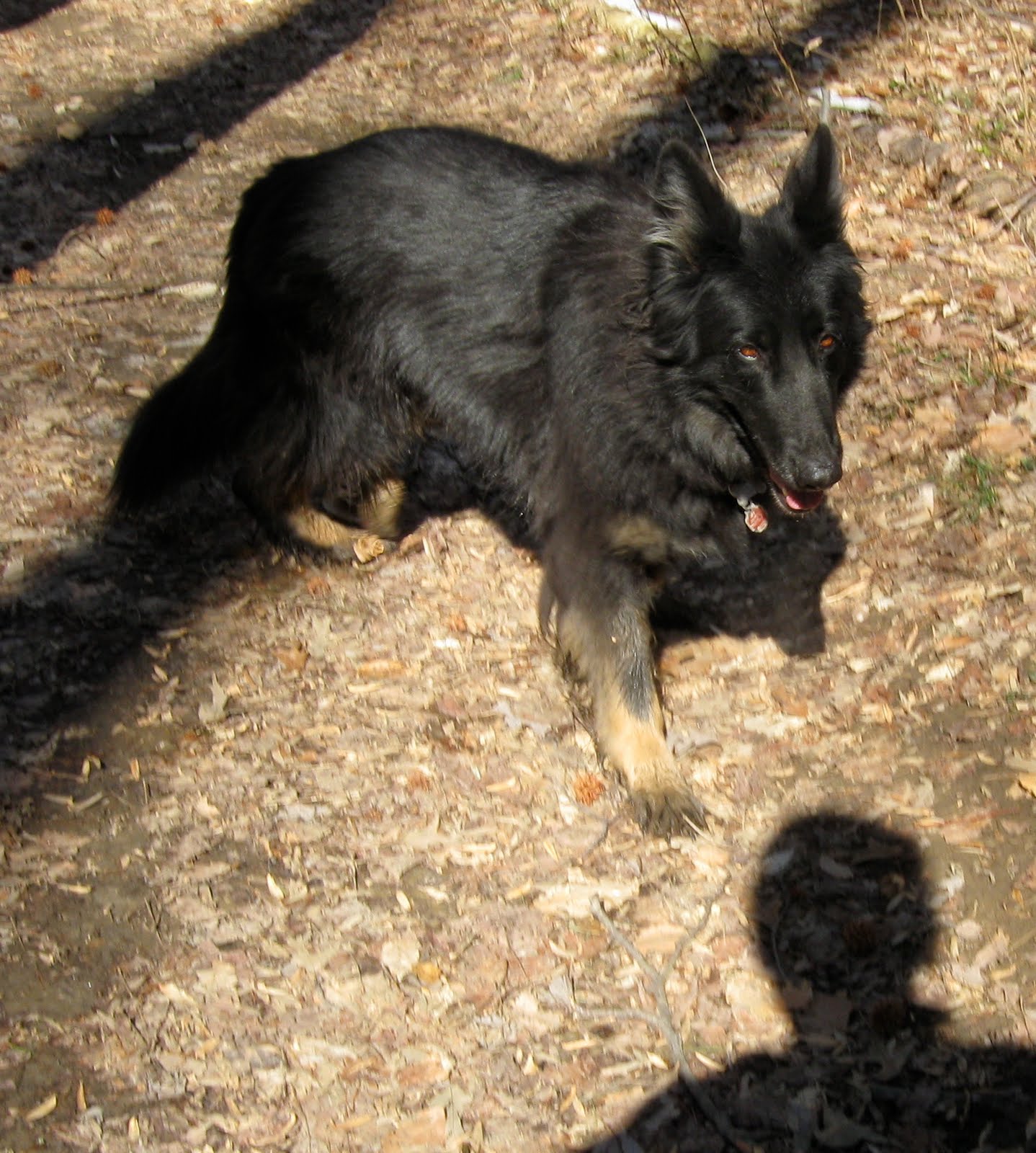
So, in this picture, is Lili a threat, or threatened? [Well, in the event, neither, since the shadow is cast by her trusted Pack Leader.] But if she were confronting a stranger, the correct answer would be “both.” Next time you encounter a dog who’s “going to General Quarters” [or find that the Wolf in Your Head is howling], you might try a little musical reverse-engineering, yourself.

Leave a comment

Filed under aggression happens, limbic system, semiotics