Plot-twists in Your Storyline


Okay, so you’ve faced the fact that something unforeseen, unintended, and probably unfortunate is going down in your life. Well spotted. Now what?

Anger, is what. Anyone who says otherwise isn’t telling the truth, or paying close enough attention. It is what to do with/about the anger, that I want to address…right after I declare how angry I am at two Post-modern Antipodeans from the 70s, White & Epston, who rebranded the ancient & universal practice of chronicling the ups & downs of the story of one’s life, to try to make sense of it [to answer Alfie’s (1966) question, “What’s it all about?”] as “Narrative Therapy,” as if it were their intellectual property. Mostly intrusion is up my nose, about this narrow redefinition of what almost everyone does, every day (even if they’re not in psychotherapy): tell someone [even if it’s only Dear Diary] wha’ happened today, in a narrative format. Nar’mean?

“What did you do at school today?” ask the concerned parents.”Ahh, nuttin’. We just had oral review.” It’s still a narrative.

But let’s say what your 5th-grade class did today was study the oyster, including the requirement to eat one [which your personal & family culture proscribes], and you refused, and were sent to the Principal’s office, occasioning humiliation and fear. As you tell your narrative to your parents, they have the power to influence the storyline, for better or worse. “That’s outrageous! How dare they impose their parochial, regional folkways on a Navy kid! We’ll send a note of protest to the Principal, insisting that you be exempted, without prejudice, from eating a mollusk.” Or…”What makes you think you can defy your teacher? When in Rome, do as the Romans.” Want to guess how the narrative unfolded for me? It was huge! It became a leitmotif of my storyline. My parents backed me to the hilt, and no mollusks were consumed [by me, or, indeed, any other squeamish classmates].

As we mature, we sometimes have to “become are own parents,” and back ourselves to the hilt, in the face of criticism, adversity, and unfortunate plot-twists. That is, we need to recall earlier chapters in our narrative, when intrusion, humiliation, fear and pain & suffering were neutralized [made “all better,” or at least ratcheted down to a tolerable level], against all odds. If those instances don’t readily spring to mind, then look harder for them. If they hadn’t occurred at all, you wouldn’t be here now.

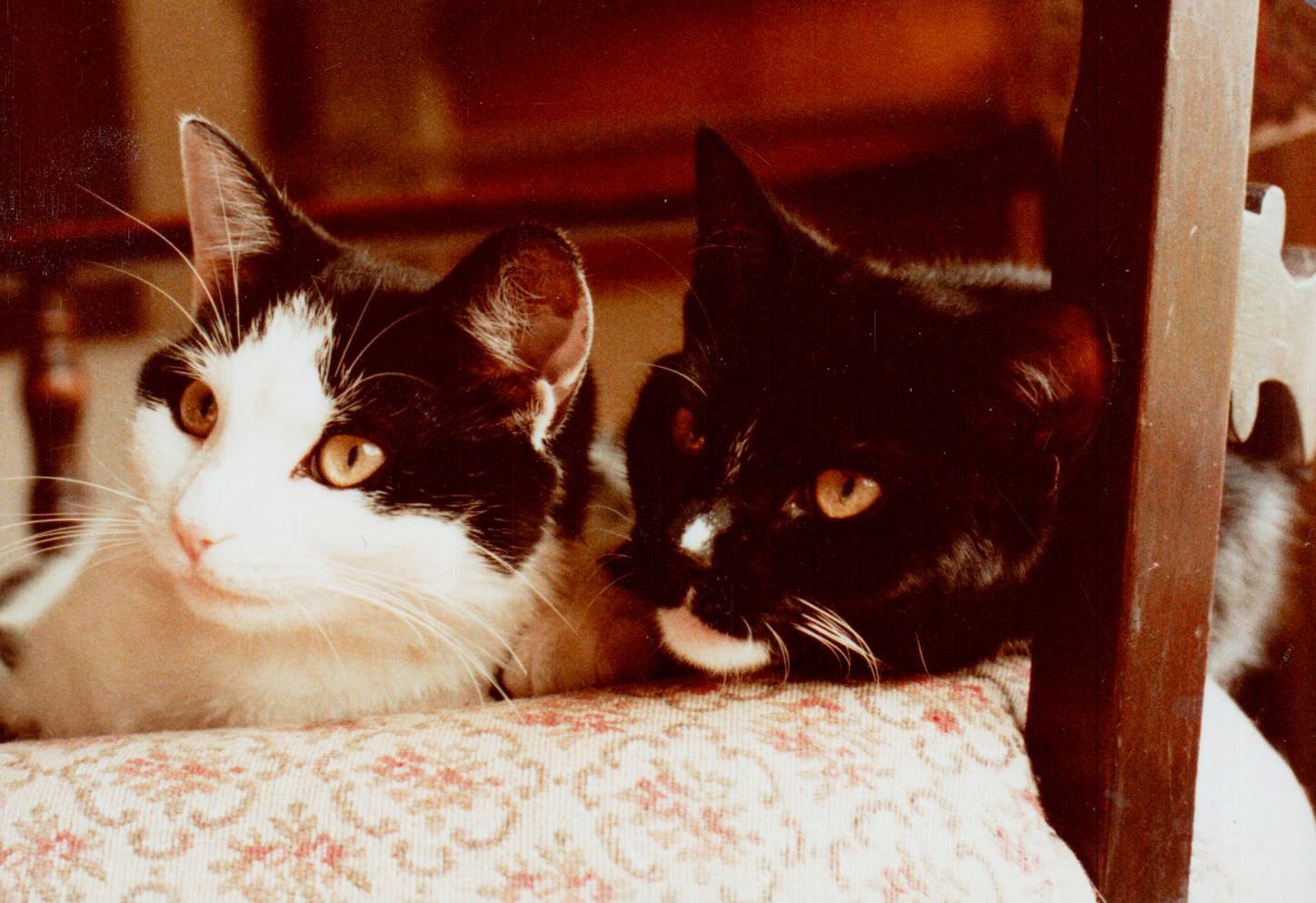
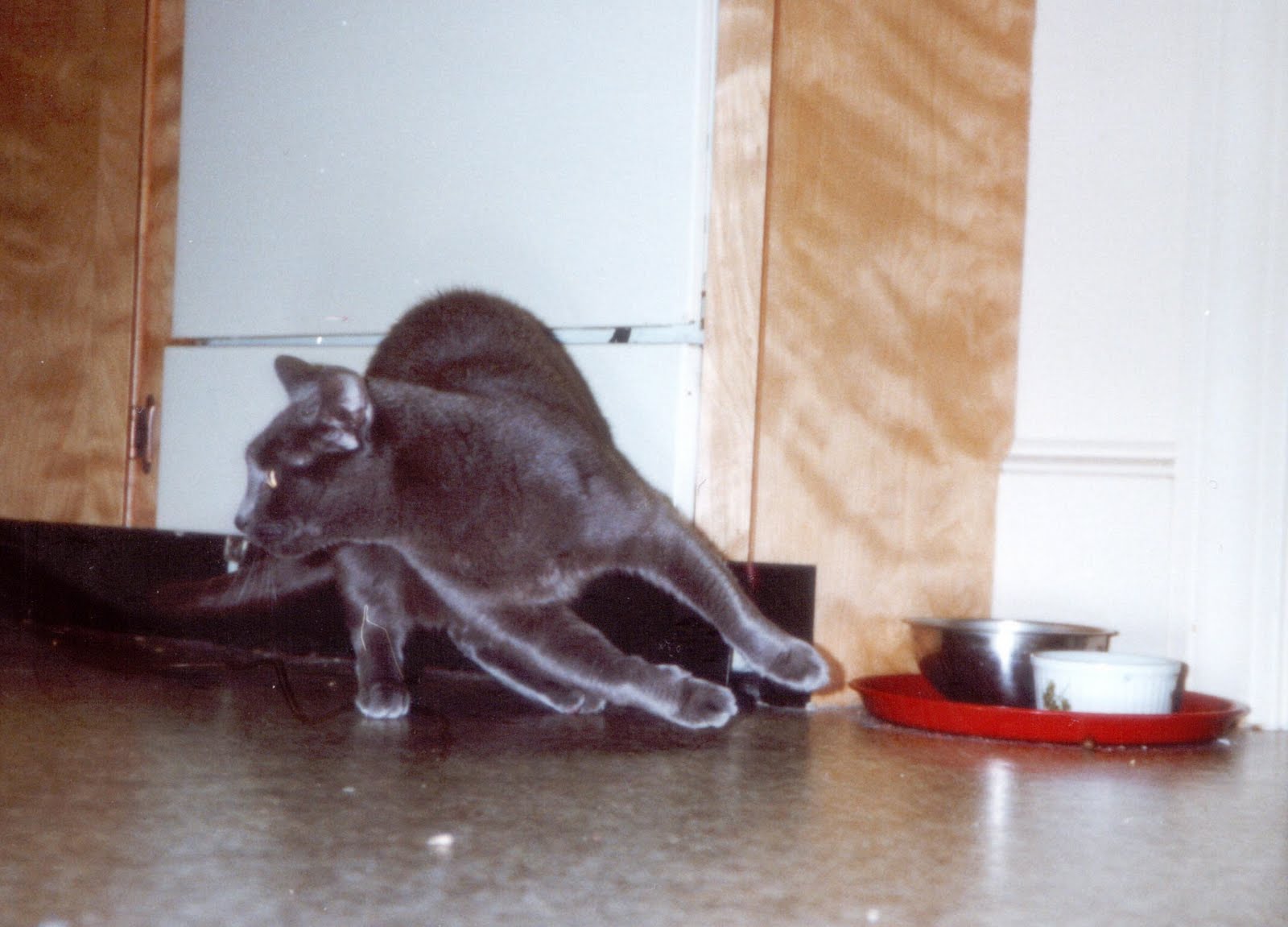
This is my Manhattan cat, St. Chuck [1974-1983], whose own storyline included a series of [at least 8] life-threatening plot-twists and miraculous comebacks. He was my loyal companion through a doctoral dissertation, 6 years of Naval service, and the transitions to married and civilian life. As this stop-action photo suggests, the leitmotif of his narrative was fear, which he overcame in his final years…which is a story for another time.
Leave a comment

Filed under gets right up my nose, locus of control, transitional objects, what's it all about?

What’s keepin’ ya?


My paternal grandmother Kate grew up on Inishmore, the largest of the Aran Islands across the Galway Bay from mainland Eire, and spoke not only Irish Gaelic, but a West of Ireland dialect of English. Consider her nuanced expressions for the verb to die: if someone kills you, you are “destroyed”; if you drown [see Riders to the Sea] you are “lost”; but if you die of an illness , you “get away.” [The custom on the islands is that your survivors must then “go tell the cows and the bees” of your demise. Dunno why…]

As a 5-year-old, visiting Kate in her final days, I was captivated by the idiom, to “get away.” It made it seem as if each of us is just temporarily tethered here on earth, like a helium balloon anchored by a little weight, one scissor-snip away from escaping the bonds of earth. So, what’s keeping us here? What are those “little weights,” which serve as our Life Anchors?

This is actually [excuse the pun] a heavy Existential question, to be asked of anyone who has attempted [or is contemplating] suicide, or who is coping with seemingly intolerable pain & suffering, and especially those grieving the loss of a loved one. The question is: “Who are your Life Anchors?” Who needs you to stick around, here on Earth? Actuarial studies suggest that if your life partner “gets away,” unless you have other Life Anchors, you are likely follow The Departed, within 12 months.

But here’s the Beauty Part [for everyone but the undertakers]. Life Anchors come in all shapes and sizes, and need not even be human, to keep you tethered. Pets prolong life, as do other individuals who are counting on you. They help you experience your own adverse circumstances as “highly inconvenient,” rather than intolerably “awful.” As the English would say, they help “take you out of yourself.” When my Uncle Dick “got away,” my Auntie Eileen [Kate’s daughter, much to their mutual chagrin], who had always been a cat person, became a Full On Cat Lady, feeding and sheltering as many as 20 at a time. Although they made her [even more] unpopular with some of her neighbors, those cats kept her anchored in life for 13 years of widowhood. Cheap at half the price, innit?

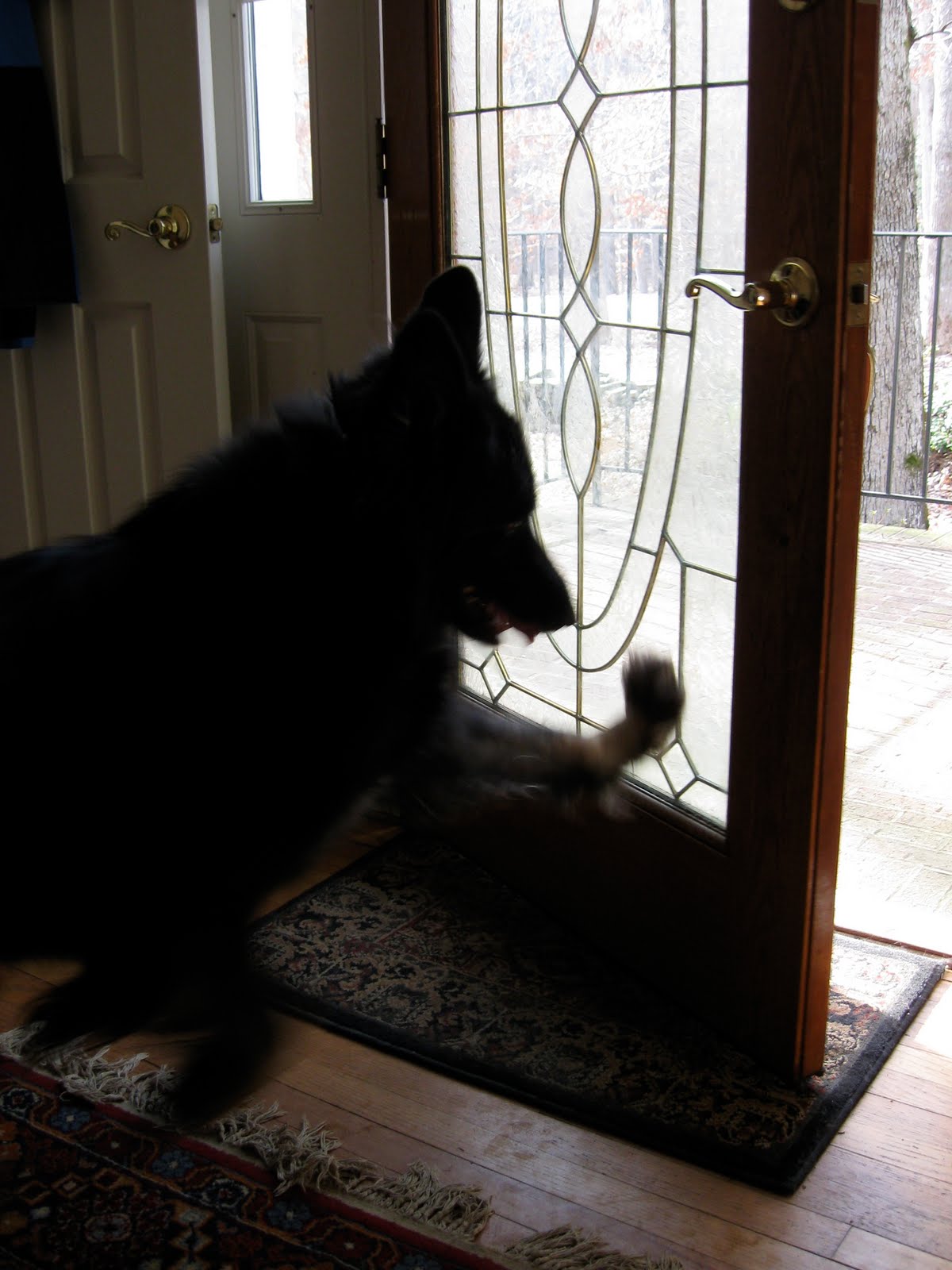
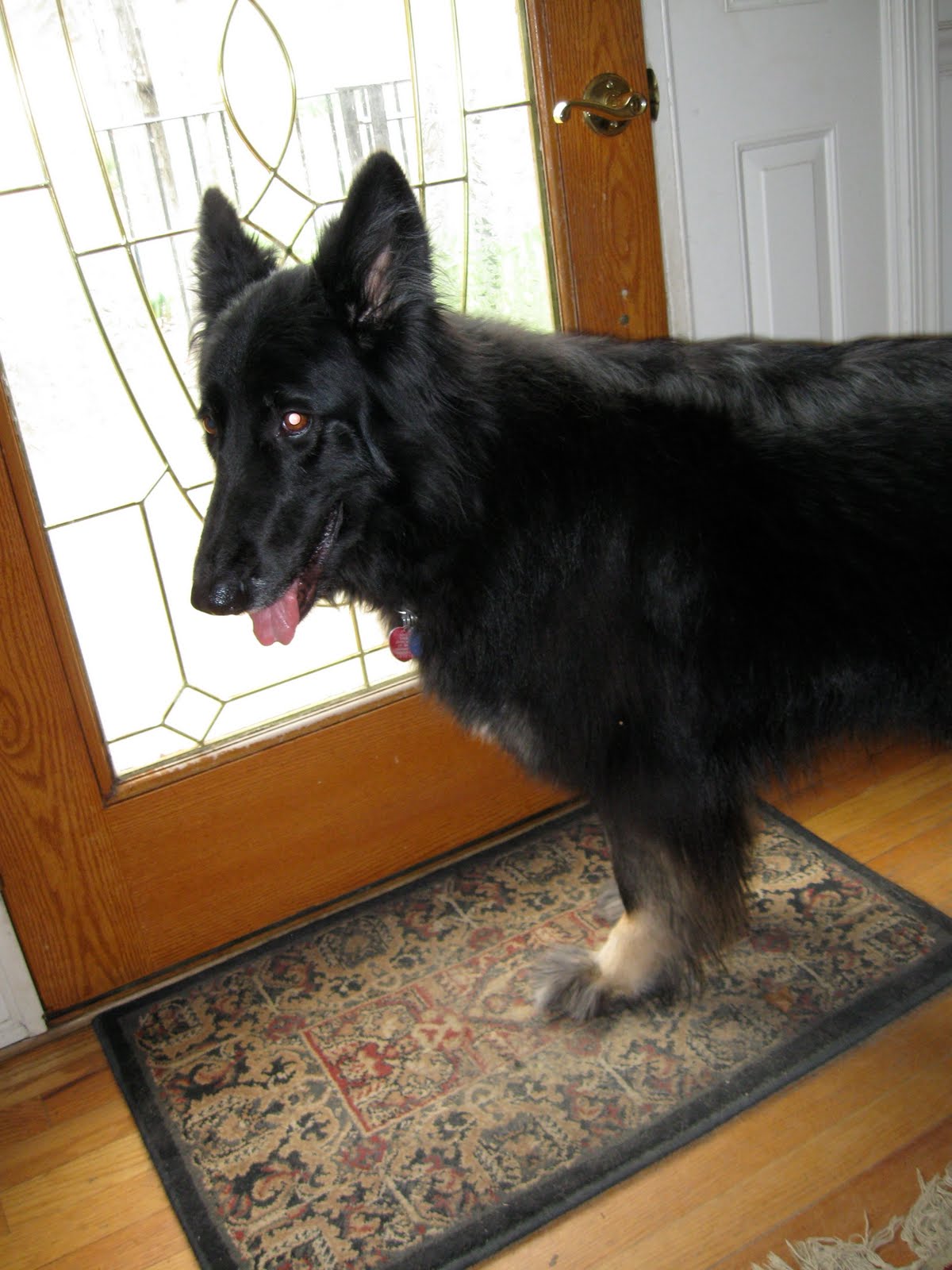
It goes without saying that Lili is one of my Life Anchors, along with my human family. What’s keeping her, in this picture? After all, this is one of two doors she can open from the outside and shut behind her. I’d like to believe that I am Lili’s Life Anchor, keeping her near through bonds of mutual love and loyalty. But it’s more likely her lack of opposable thumbs, innit?

Leave a comment

Filed under magical thinking, object relations theory, transitional objects

Move It or Lose It


How’s this for a high-concept article title? Not mine. This one, hot off the press from the Proceedings of The National Institute of Sciences: “Running enhances spatial pattern separation in mice.” A research team headed by David J. Creer in Baltimore & Timothy J. Bussey @ Cambridge University studied adult mice [3 months old] and “very aged” mice [22 months old]; and determined that adults with nifty, blue plastic, saucer-shaped exercise wheels in their cages [which they ran on, for up to 12 miles a day] enjoyed “synaptic plasticity and hippocampal neuro-genesis,” and could do a touch-screen task [to “find Waldo,” as it were] much better than their “sedentary” comrades.

Sadly, exercise for the aged mice did not significantly improve their task performance, mainly because they couldn’t quite grasp what the cockamamie task was, in the foist place! Still, a little run on the wheel, what could it hoit? [Why I’m giving the alta cocka mice Brooklyn accents is anybody’s guess, since they were actually living in “Bal’m’re”–don’t feign incomprehension, those of you who have watched every episode of The Wire–hanging out at the National Institute on Aging.]

So, let’s extrapolate the findings [the way the BBC news release did] to humans. It may be that, not only is vigorous exercise good for “tying down cognitive Kangaroos” [so that they can sit still and focus long enough to learn stuff]; it may actually encourage the growth of new brain cells in the hippocampus [thereby benefiting both Kangaroos & Clydesdales].

Gives a whole new meaning to the term Scholar/Athlete, no?

Now, here’s what I propose for a follow-up study. Let’s re-test those 3-month-old smarty-pants rodent/athletes when they are 22-month-oldsters; and see if they retain their brainey-ness. How very cool it would be, if they did.

I wonder what the human equivalent of 12 mice-miles a day is…

Leave a comment

Filed under born to run, limbic system, murky research

Janus, the Gatekeeper


As the month named for the Greek god of “Shut it!” draws to a close, here’s a meditation on knowing when to say “Enough, already!” An article in the LA Times this week reports the results of an Australian study [through whose methodology one could drive a “ute,” but, oh, well] published in Circulation [as in cardiovascular, not newspaper] asserting, on the basis of subjects’ self-report of their hours spent watching telly in one week [What if it had been this week, and the Australian Open Tennis Tournament was on? S’truth!], that those who watched more than 4 hours per day were “18% more likely to die” than those who watched under 2 hours a day. So, what, if you have no access to telly, you’re going to live forever? Outta sight!

Their point was meant to be that prolonged sitting leads to poor circulatory health. “Switch the bloody thing off and go walkabout!” Sound advice, even if not convincingly proven by their data. I have another theory, having to do with the content of the programmes [it was Oz, after all] watched. In the photo accompanying the news release in the LA Times, a guy was doing a vigorous workout at the gym, while viewing a widescreen telly tuned to a 24-hour news channel. Was this a wry editorial decision, on the part of the newspaper of record for the TV & movie capital of the world, to undercut the message that telly viewing precludes exercise? Pretty cute, if so. Also, it’s grist for the mill for my alternative theory of what’s hazardous to one’s health: 24-hour news channels. All that vicariously traumatizing news, infinitely looped, ineptly analyzed, spun, repeated [you should excuse the expression] ad nauseam: it’s a major producer of cortisol [which the researchers did measure in their 4-hour-plus subjects, and lo, it was sky high].

I’ll wager that 4 hours spent watching comedies, well-made dramas, or sporting events [including horse racing, which produces adrenaline, not cortisol] would be much less toxic than 4 hours of looped news. Wonder if the researchers asked their subjects to list shows by name, or even by genre. Some great data-mining to be had, in them thar hills…

Whenever my clients complain of insomnia, I advise them to reduce their intake, not of caffeine, but of TV news. It is designed to hook you, to instill Fear Of Missing Out in you, to compel you to keep watching. I suggest substituting a cooler medium [in the Marshall McLuhen sense], such as newspapers [or online news sites]. They are less “in your face.” They give you the option to skim, or even [gasp!] skip, cortisol-agenic news items. To be the gatekeeper of your vicarious trauma. To say, “Enough, already!” and get back to your own, possibly less distressing and certainly more relevant, life challenges. I’m not saying you should care less about the calamities of your fellow earthlings. I’m saying you should watch less.

It’s not too late for a New Year’s resolution…

Leave a comment

Filed under confounds, murky research, stress and cortisol, vicarious trauma

Caged Beasts


Even if you don’t live in the DC area, you are no doubt aware that we here are waay past “Winter Wonderland,” and into “Wonder When It Will Ever End?” Let me count the ways this heinous weather pattern has gotten up all our noses. Intrusion: we are all under house arrest today, no matter how many hours we have already spent shoveling our driveways. Fear: as the howling winds threaten to blow our tall, spindly trees onto our house [and maybe even our heads]. As I write, we have so far been spared loss of power; but thousands have not, and are already enduring the pain & suffering of no heat, no light and [here in the countryside] no water. But, as usual, it is humiliation that seems to have turned the area’s no-ruder-than-most drivers into what-are-they-thinking-damn-the-torpedoes-full-speed-ahead suicidal/homicidal maniacs. As today’s [soggy] Washington Post Op-Ed article put it, “The snow has fallen, and the flakes are on the road.”

Unlike folks in, say, Michigan, who have grasped through years of trial & error [and no-fault collisions], the humbling fact that 4-wheel drive vehicles are not laws-of-physics-defying Batmobiles which can overcome anything Mother Nature can dish out, these Mid-Atlantic road warriors…have not. Yesterday, for a change, it wasn’t even actively snowing; and I witnessed 3 harrowing collisions, not to mention many flip-overs, all involving SUVs. They “didn’t spend all that money on an all-weather’ vehicle, to wuss around at half-speed just cuz of a little snow!” It’s loss of face they can’t abide, not loss of traction.

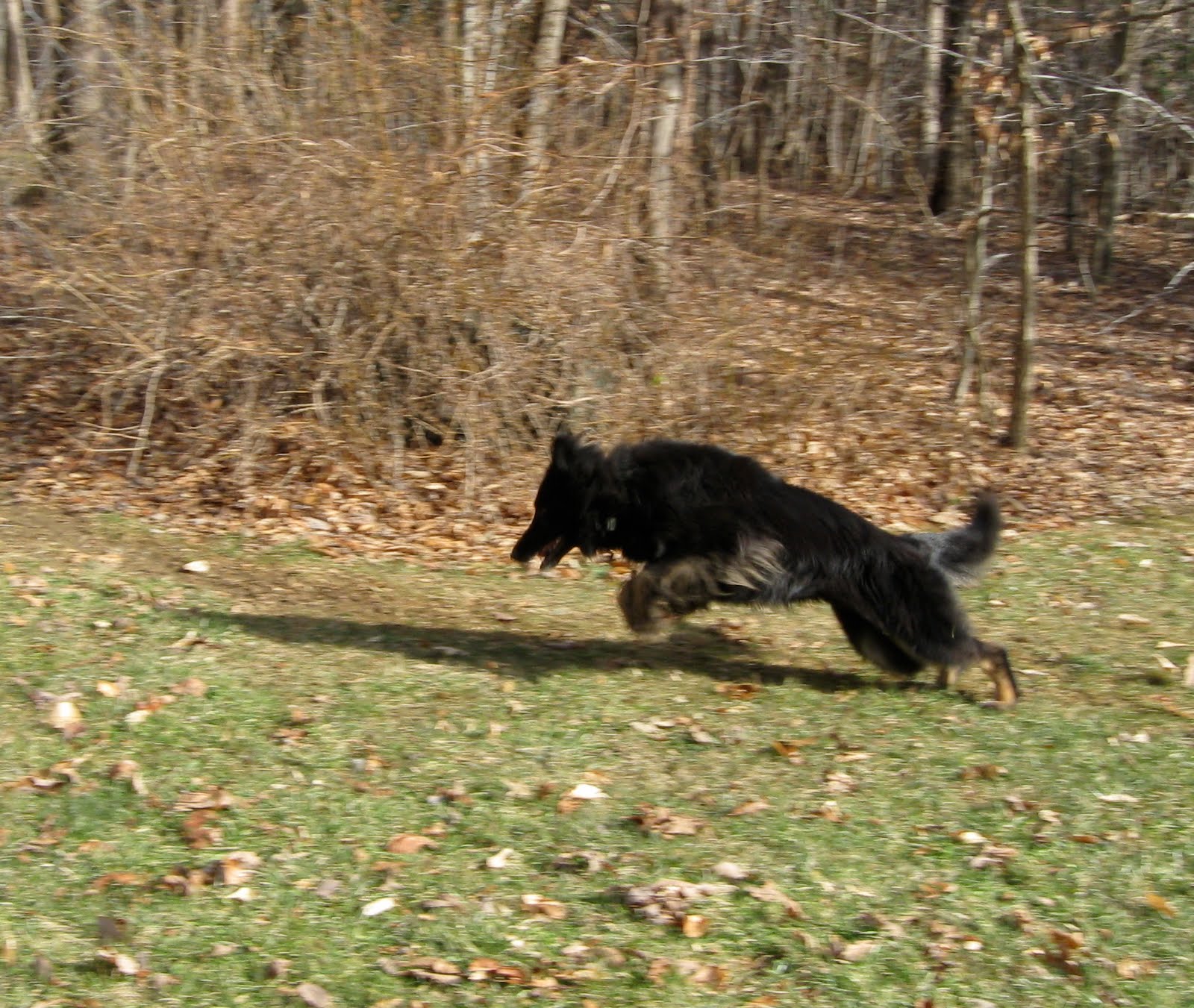
Meanwhile, this Winter of Our Discontent has taken its toll on Lili, who is used to her daily one-hour constitutional, featuring brisk trotting and exuberant running. Chris & I found one plowed section of road on the school grounds [about 100 meters long] over the weekend, and ran her to-and-fro between us like a yo-yo, commanding her, “A so ko” [over there] and “Oy i [d]e” [come to me], until [like the old mare, Dusk] she slowed to a walk. No such cleared road exists in our county today, however, so it’s plow through the 4-ft-deep snow in our yard, or pout on the porch, for our caged beast.

So far, I must say, she has maintained her “good sense, good judgment and self-control,” better than most of the snow-bound humans around here have. [I figure, it’s because she is dealing with less humiliation, innit?]

Leave a comment

Filed under born to run, gets right up my nose, limbic system, stress and cortisol

"Stuck in a Moment"


This meditation on the U2 song, which David [“Bono Vox”] Hewson has called an after-the-fact, imagined suicide intervention for his late friend, INXS frontman Michael Hutchence, is dedicated to everyone who has developed a de novo case of Seasonal Affective Disorder this winter. [More snow forecast for this evening in the DC area, tra-la.] It is also about the Gestalt psychologist Karl Duncker’s concept of functional fixity, which Corsini defines [in The Dictionary of Psychology, 2002 ed.] as “the opposite of…creative thinking.”

Consider the not-awful-just-highly-inconvenient intrusion of this prolonged spate of foul weather on Lili’s customary, daily ramble-in-the-woods. Until this weekend, the snow in the forest has been up to 3 feet deep, swallowing up the feet [and legs] of all but the snow-show-clad. The first time this happened to me, I was alone with Lili, who was off-leash but skittered over on the frozen surface, merely to bark her encouragement [impatience?] at me; and I began to fear that I would be Stuck in the Moment until the Spring thaw.

Resisting a $100 investment in snowshoes, I began searching for alternative venues for Lili to run, which were both [relatively] safe & legal. When school was canceled, the plowed parking lots were viable, except for some tricky, hard-to-see patches of ice. A couple of days we slogged through 2 feet of slush on the paved path in a local recreational park. [By the way, why all the empty parked cars in the lot? Surveillance or shenanigans?] One day we bored ourselves silly, running up & down our own cul-de-sac street, incensing all the neighbors’ penned-up dogs.

A few brilliant, but not-really-legal venues occurred to me, such as the covered parking lots @ work, the Mall, or Whole Foods. I reconnoitered them with Lili in the car; but the hostile semiotics of the security guards were discouraging. One evening at the almost deserted medical center parking structure, the golf-cart dude pulled up and asked me, “Is there a bomb scare, or something?” [Lili’s semiotics aren’t all that benign, either.] To avoid further humiliation, if not actual arrest, I loaded her up and drove slowly away.

So, there you have it, from one who prides herself on her non-linear, out-of-the-box problem-solving skills. Apparently, my amygdala has been so freaked out by the logistical challenges of this unprecedented spate of snowy weather, that it has hog-tied my hippocampus. [Note the paucity of posts in February.] Finally, this weekend, with a partial thaw and Chris at my side, we ventured into our beloved woods again. It wasn’t easy or pretty, but it was a necessary journey. It restored limbic balance, as well as hope, that “this time will pass.”

And even if Bono didn’t get to save his friend’s life with this song’s belated argument against despair, he has helped me “get myself together” this winter. Now there’s a guy not much given to functional fixity, d’ya know?

Leave a comment

Filed under limbic system, semiotics, what's it all about?

Laissez-passer


In NYC in the 70s I had not one, but two, reference groups so devoted to the 1942 film Casablanca, that they [we] had memorized every line of dialogue. Start me anywhere. If you have even a passing acquaintance with the storyline, you will recall that it’s all about which two lucky people in the Nazi-controlled city of Casablanca will ultimately get to use these travel documents [les deux laissez-passers], permitting them to hop a DC-2 to Lisbon [and thence, escape to America, which was still officially a neutral country during the filming of this movie, which is regarded by some historians as the most persuasive piece of anti-Nazi propaganda ever made].

So, anyway, all these decades on, laissez-passer [literally, “Let (to) pass.”] means a “guarantee” of a safe passage, through a perilous time or place. A get-out-of-jail-free-card, as it were. Or, in my case [I hope], a respite from the freakish weather that has made trekking through the woods “highly inconvenient.” I know, I keep banging on about this as if it were as onerous as this season’s earthquakes, tsunamis and lethal flooding elsewhere in the world. It’s just a metaphor. A synecdoche, even. The Poetic use of a small, particular thing to represent the bigger thing. Nar’mean?

And now, to my point. With regard to the weather, or tectonics, or “unexpected” acts of aggression carried out by individuals who were [inevitably, reportedly] held in high esteem by their neighbors and/or colleagues, there are no guarantees. Some major irritant seems of have gotten up Mother Nature’s nose, and she is smacking Earthlings on the snout, Big Time. Also, as you know, civil servants, just trying to do their lawfully mandated duties, have come under attack. Talk about synecdoche! The [attributed] on-line ramblings of these domestic terrorists seek to justify their lethal assaults on individuals, who, they believed, represented disagreed-with government policies. In a much milder form, as a Naval officer in the 70s, I experienced this part-whole confusion at the hands of brick- and bottle-hurling young Townies, when walking the the streets of Annapolis in uniform. The ridiculously simple laissez-passer that I “wrote” for myself was to change into civvies and take my hair down, as soon as I got home [2 whole blocks outside of Gate 1, big whoop]. It taught me to resist judging human “books” by their “covers,” as well as to be hyper-aware of the semiotics [subtext] of my dress and behavior, as perceived by others.

So, what gauntlets do you have to run this week, without the guarantee of a safe passage? I’m not trying to scare anyone. I’m giving you credit for your bravery; and encouraging you to notice what steps you take, to “write” yourself your own “laissez-passer,” that increases your sense of security.

I find, prosaically, that practical footwear helps me feel safer. Note the state-of-the-art “Bogs” boots, plus “Yak-Trax.” I only slipped once Saturday [the day this photo was taken]. To paraphrase Casablanca, “I came here [to Annapolis] for the [mild winters]. I was misinformed.”

Leave a comment

Filed under aggression happens, semiotics

The Holy Ground


True, full-time Hibernians [not youse who are bein’ Irish just for today, to honor St. Padraig] will know that the so-called “Holy Ground” of the old song [also referenced in a second song on Mary Black’s album of de same name] is not a religious place at all [like, God-save-us-all, East Jerusalem, or Mecca], but the red-light district in the port town of Cobh, in County Cork, from whence set sail many of our immigrant forebears, from the land of green fields and not enough food, to the land of green beer and food galore.

It is, thus, an ironic [Poetic] figure of speech, capturing both halves of the ambivalence which the Irish diaspora feel for their country of origin. For centuries, Eire was [as Dr. Samuel Johnson said of Scotland], “a grand place to be from.” In Mary Black’s song, “The Loving Time,” [the first line of which is, “Reads like a fairytale, cuz that’s what it was.”] it connotes the power of sentimental, romantic love to [temporarily] blind a couple to their [possibly irreconcilable] differences: “…and the Holy Ground took care of everything.” Spoiler alert. The last verse of this bravely wolf-acknowledging song begins, “It didn’t come true in the end. They went their separate ways.” Rather like Old Mother Ireland and Her then desperately hungry, later desperately nostalgic, children.

Suggested reading: Tom Hayden’s [yes, that Tom Hayden] historical and autobiographical book, Irish On the Inside.

So, here’s the point of this post. Any piece of real estate which holds powerful intimations [both sweet and bitter] of actual or legendary happenings, can become “the holy ground” for an individual, a couple, a family, or a tribe. In the Fall of 1957 my father drove through Gate 3 of his alma mater, the Naval Academy, and parked [illegally] in front of the Chapel for long enough to run into the Admin building and report for duty. My usually Stoic mother burst into tears. Was she afraid the Jimmy Legs [the Yard police] were going to ticket our car? Or was she overcome by the sight of the Chapel, where she & Rosie were married in a tiny, wartime service? Turns out the Chapel was a mere synecdoche for the whole USNA mystique, which, to one degree or another, our whole family [along with many others] have come to regard as “the holy ground.” In 1958 my mother dramatically fell ill with MS while walking on the Academy grounds; yet I found myself inexorably drawn back to live and work there, in 1976 and in 2000. And it’s not because of all the rollicking fun to be had there [especially, this last time round]. It’s because of the memories of the good and bad times I had there with The Now Departed [my parents], whose presence [I believed] would feel more palpable there, than anywhere else on earth.

It was, do you see, a Transitional Object [like a Teddy bear, or Alfred the dog, or Ciotogach the cat], that helps one to feel closer to “the ones that we love true,” to paraphrase the song.

How randomly can a place become “the holy ground”! Not for its intrinsic beauty, or bounty, or balmy weather, or enlightened folkways; but because it is the repository of memories, of Us interacting with [ambivalently] loved Others. When you’re in it [as I learned early, in my peripatetic Navy childhood] it’s often hard to believe that you’re going to look back on a place with nostalgia. I spent my first two months in England [now, the holiest of my “holy grounds”] squinting at ViewMaster reels of the Naval Academy and weeping for what was lost. Who could have imagined that, one day, I would be using Google Maps to take virtual rambles round my beloved English “home place” [as the Irish say] of Stoke D’Abernon, where Ying Tong the cat was regarded with such ambivalence [mostly, negative] by all the neighbors.

Speaking of rambles, I am wise enough to know that the South River woods [in which Lili once again warned me of a suddenly-falling-but-this-time-without-audible-warning, 30-foot tree trunk, not 20 yards ahead of us, on today’s walk] will be added to my list of “holy grounds” [if I am not struck down by falling lumber first].

Leave a comment

Filed under ambivalence, pragmatics, semiotics, transitional objects

A Sheep in Wolf’s Clothing


Early last Fall Mahmood, our termite “experimenter” [as my NYC reference group ironically referred to exterminators] came up to my husband, holding a medium-sized black snake which he had just killed in our yard, saying “I know I’m here to see to the insects; but in Morocco, where I come from, all snakes are bad.” [Ooh! Maybe he comes from Casablanca! How Poetic would that be?]

A few months later, over Thanksgiving, Chris encountered this spiffy-looking young specimen on our driveway, took its picture, and gently placed it back in the leafy undergrowth. Unlike Ireland [which is snake-free, t’anks to St. Padraig, so the legend goes], Maryland has its fair share of venomous serpents; and our visiting daughters were Not At All Happy with their father’s sudden display of ahimsa. After all, this is the guy who routinely [if inadvertently] trampled-while-pursuing the skittering chipmunks and similar fauna, with which our cats stocked our basement in Michigan, like a small wildlife preserve. So, why spare this snake?

He gave them two reasons. Because it was outside [not in our basement]; and because it “looked so little and harmless.” Thus, it did not provoke an aggressive response through intrusion or fear. This snake, it could be said, had Benign Semiotics…at least, to Chris.

Now, having grown up with Burrack, and Dusk and Owen, our girls knew that Benign Semiotics are in the eye [and species] of the beholder. All horses regard all snakes [even little ones] as alarming predators, and will often spook in a “highly inconvenient” way, if they are the first to spot one nearby, before the rider can redirect their attention. Indeed, many horses [including my uncle’s Arab gelding…hmm…a desert dweller, like Mahmood] tend to err on the side of caution, and spook histrionically at undulating garden hoses, lead-lines being gathered up, or even long cloth banners fluttering in the wind. If you are the rider, taken by surprise [and possibly thrown] by your horse’s sudden shying away from a snake-like “threat,” you are more likely to fear & loathe snakes [even little ones], through Classical Conditioning [or even One-Trial Learning]. This is how Malign Semiotics get started, nar’mean?

Chris e-mailed his snake picture to the University of Maryland Extension Program, and was informed that it was a juvenile Black Rat Snake, not venomous, and actually quite useful for natural rodent control around rural property. Mother Nature outfits the young ones in a camouflage motif, which gradually darkens to a solid black at maturity, like the one which Mahmood killed. [Yes, it might well have been “Bambi’s mother.”]

Next time you find yourself [or your horse] recoiling in alarm from a creature whose Semiotics are Malign, why not do a bit of psychological detective work? “Is the threat real, or is that outlandishly coiffed, dressed, bedizened, or named individual only the signifier of a potential threat?” To make this exercise a bit more real-world, imagine that you are standing in the security line @ BWI, behind Mahmood the Exterminator, who is trying to fly back to Morocco to see the folks from his “home place,” over Thanksgiving.

Leave a comment

Filed under ethology, limbic system, semiotics

Snakes & Ladders


David Lodge [one of my fave English authors] begins his 1980 novel How Far Can You Go? with a 1950s university student weighing the pros & cons of attending a mid-week evening church service. Aside from the expenditure of Therbligs, and forgoing more frivolous diversions with less conscientious college friends, there is the danger that holier-than-thou self-congratulation will result in a Net Guilt Gain! The author likens this hazard to the children’s game of Snakes & Ladders. Just when you think you’re ascending to the Moral High Ground, oopsie-daisy, your Pride occasions a Fall from Grace. Nar’mean?

When he chose this metaphor, I wonder, did David Lodge know that Snakes & Ladders is based on the 11th-century Hindu game Moksha-Patamu, devised to teach children how to express the 5 Virtues (while avoiding the 12 Vices), in order to reach Nirvana? [No, not the band.] Note that in the original game, there are more than twice as many “snakes” [ways to fall] as “ladders”; whereas in the UK and American versions, the ratio of “snakes[or “chutes”] to “ladders” is 1:1. [Think 7 Virtues & 7 Deadly Sins.] Wanna know the Vices the Hindu version features? [They are listed in this order in several sources. Could it be, from venial to mortal?] “Disobedience, Vanity, Vulgarity, Theft, Lying, Drunkenness, Debt, Rage, Greed, Pride, Murder, Lust.” Guess you wanna hear the Virtues now, innit? “Faith, Reliability, Generosity, Knowledge, Asceticism.” [Reminiscent, somehow, of Jonathan Haidt’s 5 Moral Spheres model, from the post, “Crime & Punishment.”]

Now, back to real snakes. In the Fall of 1984 we were living in Holden, Massachusetts [near Worcester, about which, don’t get me started; talk about ambivalence (mine), talk about a sense of moral superiority (theirs)]. “We” being self, husband Chris, 9-month-old Baby Girl, and the gifted hunters, Stella [Ciotogach-looking one] & Stanley [with the white goatee]. Chris was off being a [jolly good] Fellow @ UMass Med Center; Baby Girl was napping; and I was doing laundry in the basement on a rainy day, with Nobody’s Fool Stella keeping me company. I gathered that Sodden Stanley had popped through the catflap, because I heard a dong! as he landed on the dryer. Also, I felt his wet tail wrapping around my bare ankles. Hang on. There he sat, staring into middle distance, on the dryer…while the black snake he had brought in ascended my leg.

So, limbic system on Full Alert, I screamed, shook the serpent off, ran upstairs and donned my Wellies, ran back downstairs brandishing a golf club [no, I am not Swedish], onto which I “charmed” the snake, and thence threw it into a wicker basket, which I deftly flipped over, thereby trapping it. Unabashed Stanley was clawing at the basket, wanting to play with his “prey,” so I grabbed him and ran back upstairs to call Chris, “insisting” that he come home “right then” and “deal with” the snake. “But, you’ve already dealt with it,” he quibbled. “Just keep the cats out of the basement, and you’ll be fine.” “Nooo!” I wailed. “I’m afraid the snake is going to get out, climb up the stairs, and hurt [the baby]!” [I may be part horse.]

Having clearly exceeded the speed limit, Chris arrived shortly, flipped the basket over, bashed the snake with the golf club, saying “There!”; hopped back in his car, and returned to the hospital.

Poor old snake! Wrong place at the wrong time. [In Stanley’s line of sight on a wet Wednesday.]

Chris and I both lost many karmic points that day. Yet, search as I may, I can’t find my crime on the Hindu list of 12 Vices. I can identify what Got Up My Nose, though. Intrusion of an unexpected creature [not even a furry one] into my home and onto my person. Fairly far-fetched fear, that the snake would glide up the basement stairs and under a closed door, to strike at my baby [even though it had been so gentle with me, that I mistook it for my cat]. But, most shame-making, the humiliation of not being taken seriously by my husband. As if I were some [gasp!] Drama Queen, or something.

Chris would no doubt say that he displaced his Rage [at my intrusion on his workday, and possibly the humiliation of being regarded as a hen-pecked husband by his fellow Fellows] from me, onto the hapless snake. No wonder, 25 years later, he helped the young snake on our driveway to live another day. After all, if reincarnation is true, that could be you or I, Next Time.

Leave a comment

Filed under aggression happens, gets right up my nose, lesser of two evils, limbic system